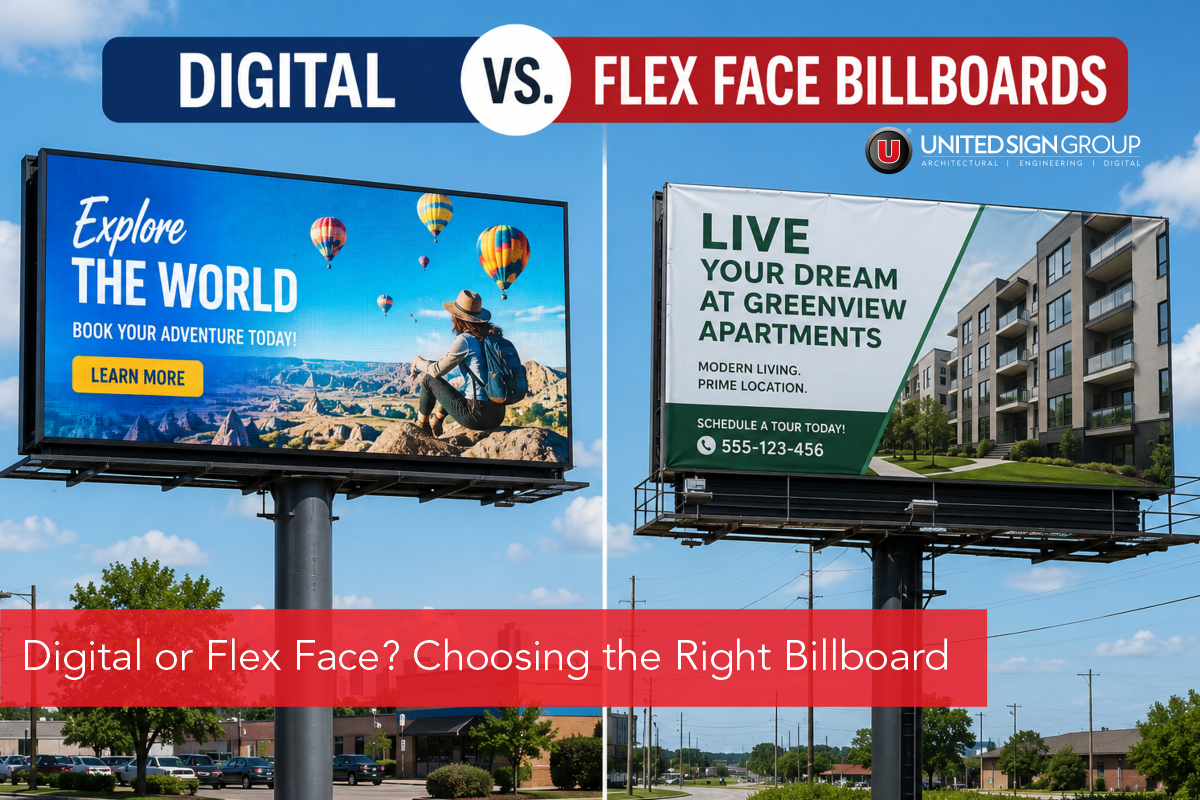
Every billboard project eventually comes down to the same question: digital vs flex face billboard, which one actually fits your site? Both are legitimate options, and neither one is universally better. The right call depends on your budget, your site, and how often you actually need the message to change. Here’s how to think through it.
Start With What Each One Actually Is
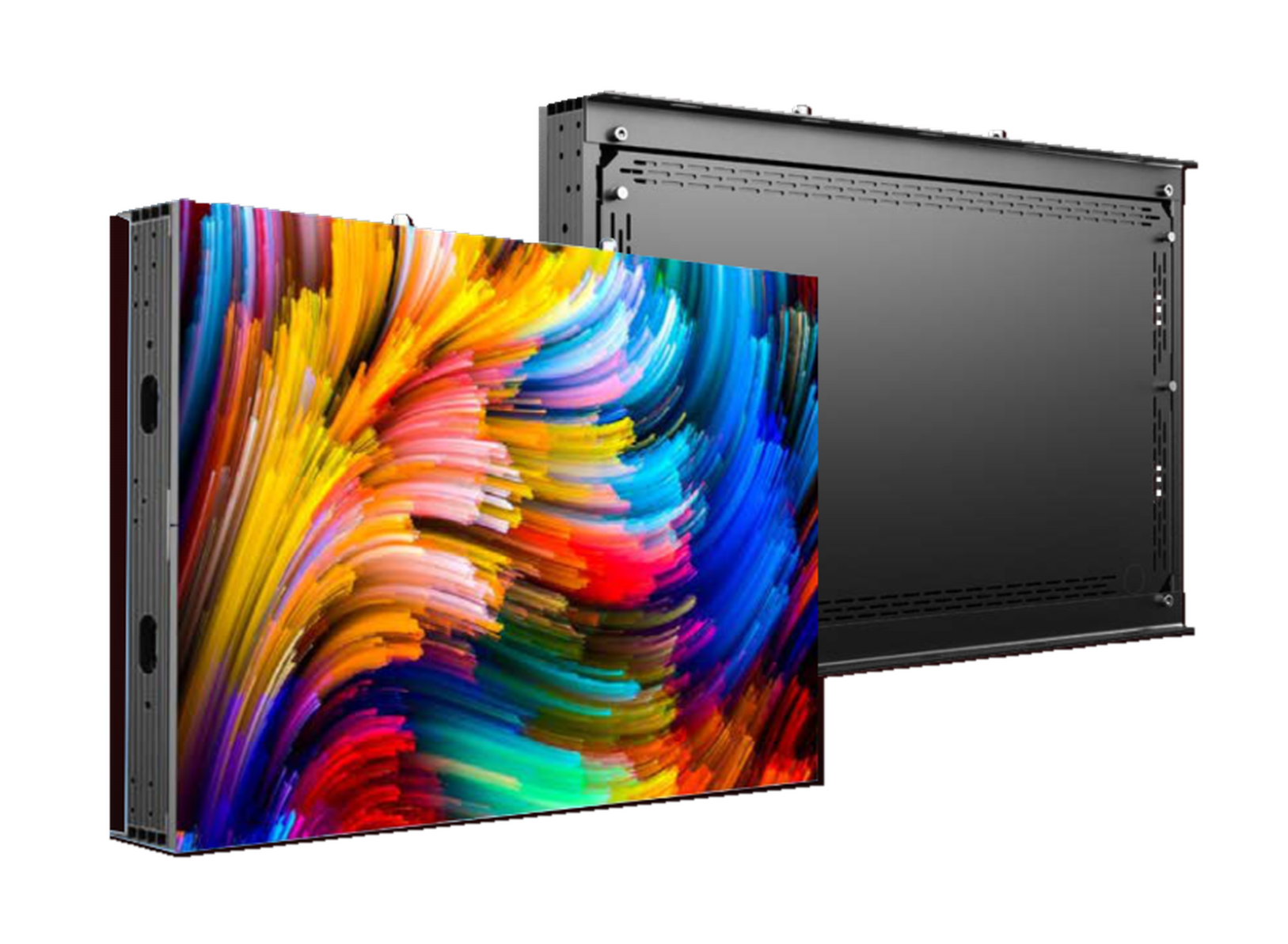
In contrast, A digital billboard uses an LED module that displays content electronically, and that content can be updated remotely without anyone visiting the site.
A flex face billboard uses a tension frame with a flexible vinyl or fabric material stretched across it. Installers set the message when they install the face, and changing it means producing and physically installing a new face.
However, neither is inherently the “upgrade.” They solve different problems.
Digital vs Flex Face Billboard: Flexibility vs. Upfront Cost
Digital costs more to build. You’re paying for the LED module, wind load engineering for a heavier structure, and a power and content management setup. In exchange, you get a display that can change its message as often as you want, at close to zero cost per update.
Flex face, on the other hand, is the cheaper build. Simpler frame, lighter materials, no electronics to speak of. The catch shows up later, not upfront. Every time you want to say something new, you’re paying for a new face and another install. Do that a few times a year and it adds up fast.
So really it comes down to how much your message actually moves. Running the same thing for years with no real plans to change it? Flex face wins on cost, easily. But if you’re swapping content often, running seasonal deals, splitting time between advertisers, or targeting different crowds throughout the day, digital starts pulling its weight. The higher price tag up front stops mattering once you factor in what you’d have spent reprinting a flex face over and over.
Traffic and Advertiser Demand Matter More Than You’d Think
This is really where the digital vs flex face billboard decision becomes site-specific rather than a matter of preference.
For example, a high-traffic location with real advertiser demand is where digital tends to perform best, since a digital structure can rotate multiple advertisers on the same physical sign, generating more potential revenue than a static face selling one ad slot.
On the other hand, a lower-traffic site, or a location where you’re the only advertiser and plan to stay that way, may not generate enough additional value to justify digital’s higher build cost. In that case, flex face can be the financially smarter choice, even though it’s the “simpler” technology.
Digital vs Flex Face: Maintenance Differences
Flex face maintenance is mostly about the material itself: checking tension, inspecting edges and tracks, and occasionally cleaning the surface to keep backlit color sharp. Most flex face substrates are built from vinyl coated polyester, which is engineered for tear resistance and long-term outdoor durability. There’s no electronics to maintain.
Digital maintenance includes the LED modules, power supplies, and any content management software or connectivity keeping the display synced. Manufacturers typically rate LED modules for well over 100,000 hours of use, tied to how LED efficiency degrades over time, which translates to roughly 10 years or more before brightness degrades meaningfully. Still, digital systems have more components overall, and budgeting for occasional service is part of owning one.
Permitting Can Tip the Decision
Local ordinances sometimes make this choice for you. Digital billboards, particularly those with animation or frequent content changes, often face more scrutiny around illumination and animation rules than static flex face structures. It’s worth confirming what’s actually permittable at your specific site before deciding, since a digital build isn’t worth much if local code won’t allow it to operate the way you need.
Side-by-Side Comparison:
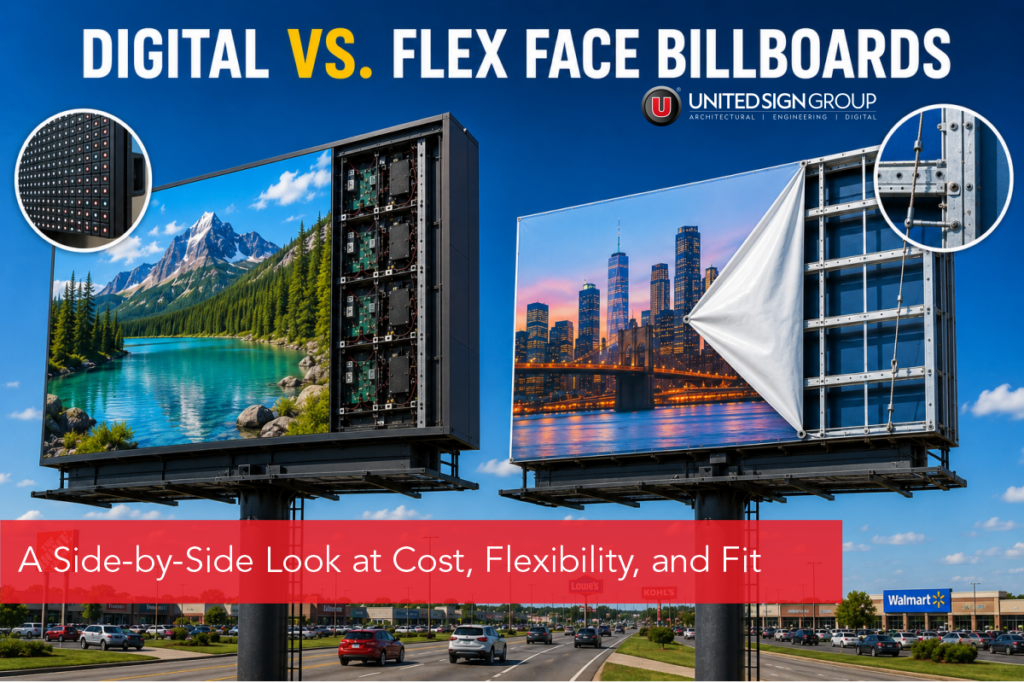
Here’s the digital vs flex face billboard comparison side by side.
| Factor | Digital Billboard | Flex Face Billboard |
| Upfront cost | Higher | Lower |
| Cost per message change | Minimal, updated remotely | Repeats with each new face production and install |
| Ad revenue potential | Multiple advertisers can rotate on one structure | One advertiser per face at a time |
| Best traffic fit | High-traffic, multi-advertiser locations | Lower-traffic or single-advertiser sites |
| Maintenance focus | LED modules, power supply, content system | Tension, material condition, surface cleaning |
| Permitting complexity | Often more involved | Generally simpler |
| Best for | Frequent updates, seasonal promotions, ad revenue | Long-running messages, tighter budgets |
A Few Questions to Ask Before Deciding
- How often does this message actually need to change?
- Is there enough traffic and advertiser interest to fill a rotating digital schedule?
- What do local ordinances allow at this specific site?
- What’s the realistic budget for build cost versus ongoing production costs?
- Would retrofitting an existing structure, in either direction, make more sense than a new build?
There’s No Universal Right Answer
A flex face billboard with one strong, long-running message can outperform a digital build on cost efficiency at the right site. A digital billboard earns back its higher cost through flexibility and multi-advertiser revenue at a high-traffic location. The decision comes down to how the site will actually be used, not which format seems more advanced.
Side-by-Side Comparison
| Factor | Digital Billboard | Flex Face Billboard |
| Upfront cost | Higher | Lower |
| Cost per message change | Minimal, updated remotely | Repeats with each new face production and install |
| Ad revenue potential | Multiple advertisers can rotate on one structure | One advertiser per face at a time |
| Best traffic fit | High-traffic, multi-advertiser locations | Lower-traffic or single-advertiser sites |
| Maintenance focus | LED modules, power supply, content system | Tension, material condition, surface cleaning |
| Permitting complexity | Often more involved | Generally simpler |
| Best for | Frequent updates, seasonal promotions, ad revenue | Long-running messages, tighter budgets |
A Few Questions to Ask Before Deciding
- How often does this message actually need to change?
- Is there enough traffic and advertiser interest to fill a rotating digital schedule?
- What do local ordinances allow at this specific site?
- What’s the realistic budget for build cost versus ongoing production costs?
- Would retrofitting an existing structure, in either direction, make more sense than a new build?
There’s No Universal Right Answer
A flex face billboard with one strong, long-running message can outperform a digital build on cost efficiency at the right site. A digital billboard earns back its higher cost through flexibility and multi-advertiser revenue at a high-traffic location. The decision comes down to how the site will actually be used, not which format seems more advanced.
Enjoyed This? You Might Also Like: Flex Face Framing 101: Materials, Installation & Upkeep
FAQs
Often, yes, depending on whether the existing structure can support the added weight and wind load of a digital cabinet. An evaluation of the current structure is the necessary first step.
Not necessarily. It depends on traffic, advertiser demand, and how often the message needs to change. A low-traffic site with one long-running message may see a better return with flex face.
Generally, yes, since digital systems have more components, including LED modules, power supplies, and content management software. Flex face maintenance is mostly focused on the material and tension frame.
It can. Digital billboards, especially with animation or frequent updates, often face more scrutiny under local illumination and animation ordinances than static flex face structures.