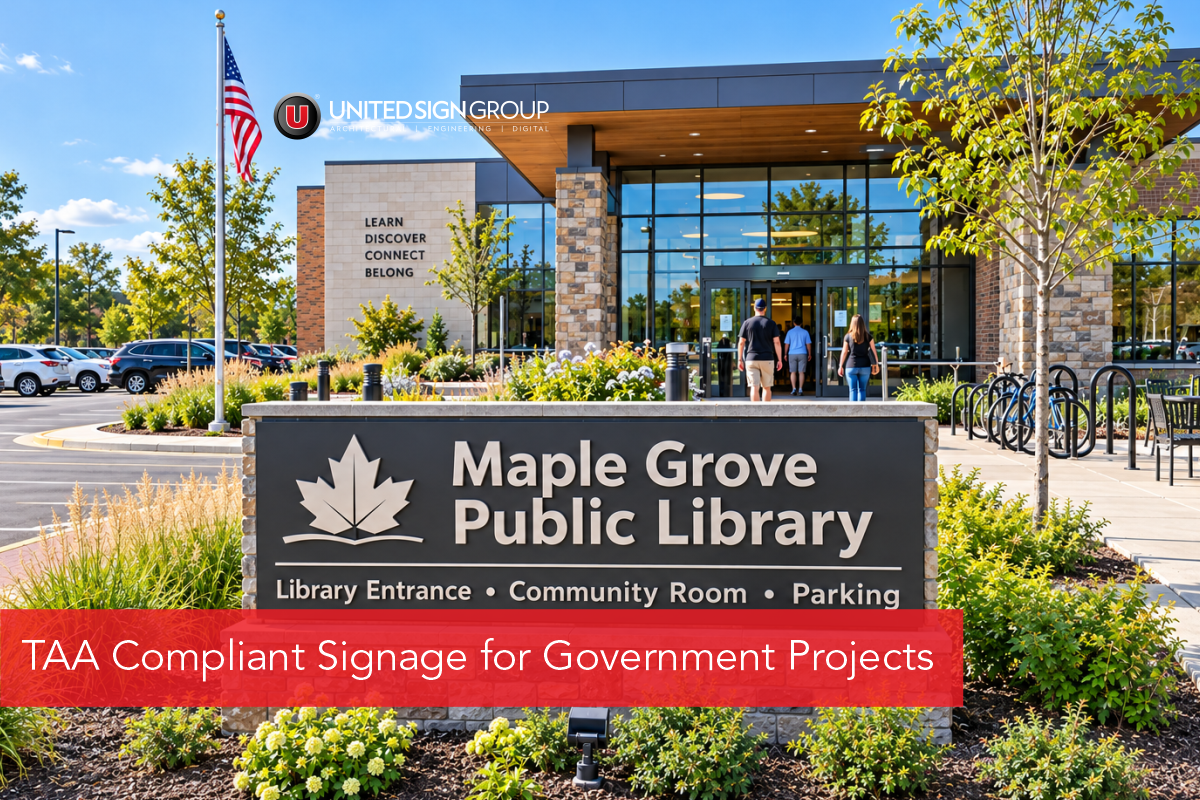
Government buyers cannot purchase signage the way a retail chain does. In fact, federal purchasing rules limit where products can come from. Because of that, TAA-compliant signage has become a basic requirement on many public-sector projects. United Signs is TAA compliant, and this post explains what that means in practical terms.
What TAA Compliance Means
The Trade Agreements Act (TAA) is a U.S. federal law. It governs which countries a product can come from when federal agencies buy it on covered contracts. In general, a compliant product is either made in the United States or made in a designated country.
Here is the key point. The law looks at where a product is substantially transformed into its final form. Where a single part was sourced matters less. Consequently, a product can contain imported components and still qualify.
The rules live in the Federal Acquisition Regulation. You can read the official text in FAR Subpart 25.4.
Why TAA Compliant Signage Matters for Government Buyers
Compliance affects a project long before anyone installs a sign. Here is where it usually shows up:
- Bid evaluation: Contracting officers can reject offers that include non-compliant products
- Schedule purchasing: Many federal purchasing vehicles, including GSA schedules, require TAA compliant products
- Contract risk: A product that fails the origin test can delay a project or force a replacement
- Supply chain confidence: Agencies want clear answers about where their products come from
State and local projects follow their own procurement rules. However, federal funding often brings origin requirements along with it. As a result, many public-sector buyers ask for TAA compliance even when a project is not purely federal.
How TAA Applies to Signs
At first glance, a sign looks simple, but it has many parts. A typical government sign program might include:
- Aluminum, acrylic, or composite panels
- Tactile characters and Braille elements
- Posts, brackets, and mounting hardware
- Illumination components on lit signs
- Electronic components on digital signs
Overall, each project has its own bill of materials. Therefore, origin questions get more detailed as a sign gets more complex. Digital and illuminated signs usually need the closest review. Flat architectural signs are often more straightforward.
Ultimately, the buyer’s real question stays the same on every project. Where is the finished product made, and can the seller document it?
How United Signs Supports TAA Compliant Signage Projects
For example, United Signs works with government and institutional clients on signage programs of all sizes. On these projects, the company acts as the single point of responsibility. It coordinates design, engineering, permitting, fabrication, project management, and installation through its nationwide network.
For buyers who need TAA compliant signage, that structure helps in three ways:
- Early origin review: The team checks materials and components during design, before fabrication begins
- Documentation: Country-of-origin documentation goes out with product submittals before fabrication
- One point of contact: Compliance questions go to a single project team, not to several vendors
This approach fits how design-build signage programs already run. Origin decisions get made alongside design and engineering decisions, not after them.
Where TAA Compliant Signage Comes Up Most
Specifically, government and public-sector programs often include these sign categories:
- ADA and interior wayfinding signage for hospitals, courthouses, and office buildings
- Exterior wayfinding and monument signs for municipal campuses
- Building identification for schools, universities, and public facilities
- Digital and LED signage for lobbies and public information displays
Each category carries its own accessibility, code, and material requirements. TAA compliance adds one more layer to check, and it works best when the team addresses it early.
How to Confirm TAA Compliance Before You Buy

Instead, buyers should not assume compliance. Instead, take these steps on any government signage purchase:
- Ask for written confirmation of TAA compliance for the specific products quoted
- Request country-of-origin information for major components
- Confirm where final assembly and fabrication take place
- Review the documentation before approving submittals
- Work with a vendor that already understands federal procurement
These steps take little time. They also prevent expensive surprises after the award.
The Bottom Line
TAA compliant signage keeps government projects moving. It protects bids, supports procurement rules, and gives agencies confidence in their supply chain. United Signs is TAA compliant and handles origin questions as part of a coordinated design-build process.
If your agency or contractor team is planning a signage program, request a quote from United Signs and share your compliance requirements up front.
FAQs
It means the finished sign is made in the United States or in a designated country under the Trade Agreements Act. The origin test focuses on where the product is substantially transformed.
No. TAA applies to covered federal acquisitions, and many schedule contracts require it. State and local projects follow their own rules, though federal funding can add requirements.
No. They are separate rules with different origin standards. Buyers should check which requirement their solicitation cites.
Ask for written confirmation and country-of-origin documentation before approving submittals. Also confirm where final fabrication and assembly happen.