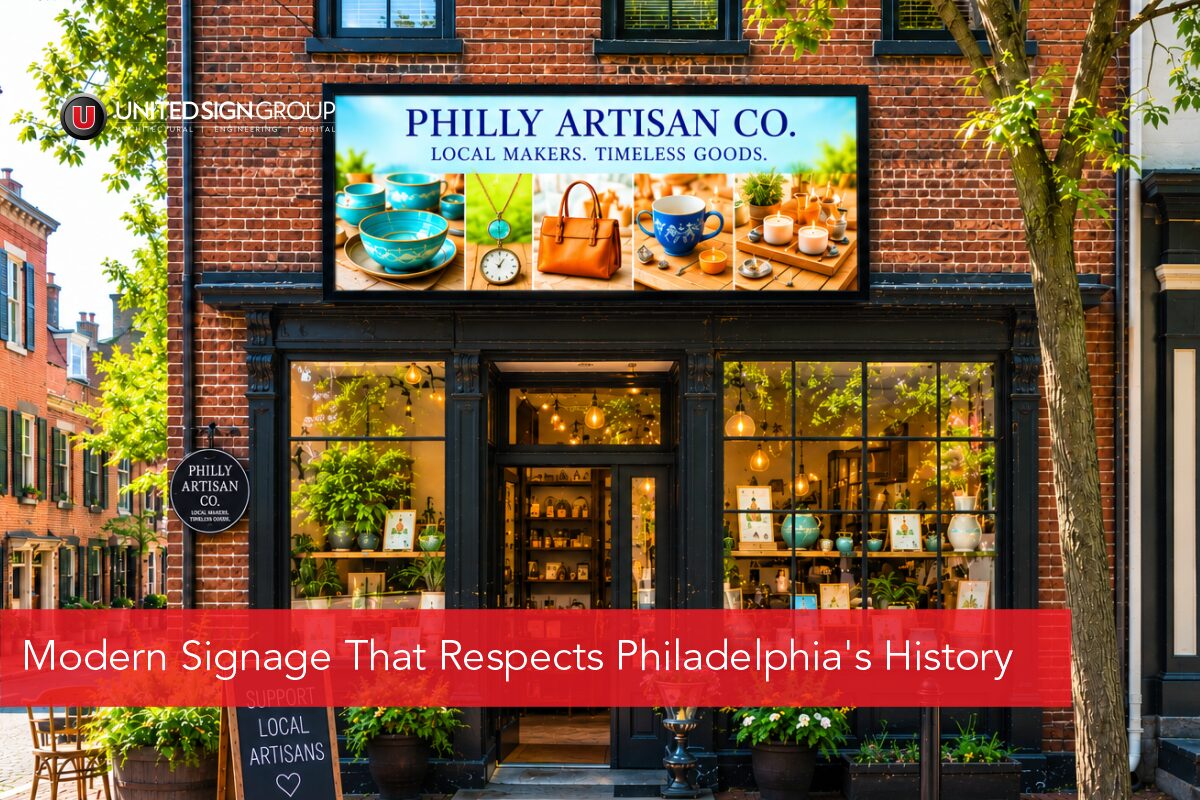
Outdoor LED signage in Philadelphia asks more of a display than most cities do. A storefront in Old City or Society Hill isn’t just competing for foot traffic. It’s sitting inside a streetscape the city actively works to protect. That means an outdoor LED display here has to satisfy both a business owner’s need for visibility and a review process built around preserving historic character. That tension is real, but it’s manageable once you understand how the pieces fit together.
Outdoor LED Signage in Philadelphia: Why Historic Districts Add a Layer
Every sign in Philadelphia goes through the Department of Licenses and Inspections. That means two separate approvals: a zoning permit covering sign type, size, and illumination, and a building permit covering structural installation. Both are filed through the city’s eCLIPSE portal.
For properties on the Philadelphia Register of Historic Places, within a historic district, or in a protected streetscape, there’s an additional step. Art Commission review happens before L&I can issue a permit, and it’s coordinated through eCLIPSE at the zoning stage. This is the piece that catches business owners off guard. It’s easy to assume a storefront isn’t in a historic district when it actually is.
Why Philadelphia’s Digital Signage Rules Add Extra Planning
Outdoor digital displays don’t move through Philadelphia’s faster review tracks. Animated, flashing, and intermittent signs are restricted across most commercial zoning districts and don’t qualify for the city’s expedited EZ Permit process, which is reserved for simpler flat wall signs. Digital displays require full plan submission and complete L&I review instead.
This means a digital sign project, historic district or not, needs to be planned around a longer timeline, one of the realities of outdoor LED signage in Philadelphia that catches owners off guard. A standard L&I review typically runs 15 to 20 business days, and historic properties add Art Commission coordination on top of that.
How Sizing, Mounting, and Scheduling Help a Display Fit
The good news is that a modern LED display and a historic streetscape aren’t automatically at odds. A few design choices make the difference:

- Right-sizing the display to the building’s frontage and the district’s character, rather than defaulting to a standard commercial size.
- Mounting decisions that respect the facade. Philadelphia’s older building stock includes a lot of masonry, brick, and steel-frame construction, and mounting needs engineering that accounts for the specific structure, not a generic bracket.
- Content scheduling that fits the setting. Static or slow-transitioning content tends to align better with historic district expectations than fast-changing animated messaging, and it can also simplify the Art Commission review itself.
None of this means giving up digital signage in a historic area. It means designing around the review process instead of running into it partway through a project.
A Practical Checklist for Outdoor LED Signage Philadelphia Projects
- Confirm your zoning district and historic status early. Don’t assume, since Art Commission jurisdiction isn’t always obvious from the street.
- Ask whether your sign concept qualifies for EZ Permit or needs full review. Digital and animated displays generally require the full process.
- Plan your timeline around both permits. Zoning and building permits are separate filings, and historic properties add Art Commission review on top.
- Get engineering drawings suited to your building type. Masonry and older steel-frame facades need mounting plans specific to that structure.
- Design content with the district in mind. A display built around clear, well-paced messaging tends to move through review more smoothly than one built around constant motion.
Why Outdoor LED Signage in Philadelphia Needs Careful Planning
A sign project that hits an Art Commission delay partway through costs real time and money, which is exactly why outdoor LED signage in Philadelphia needs planning from day one. Planning for Philadelphia’s two-permit process and historic review from day one is far less costly than redesigning after a rejection.
United Signs: Outdoor LED Signage Philadelphia Experts
Working through L&I’s eCLIPSE process, EZ Permit eligibility rules, and Art Commission coordination takes a team that handles this regularly. United Signs manages the full process in-house for Philadelphia projects, from zoning and site review through Art Commission coordination, PE-sealed engineering, fabrication, and final Certificate of Approval, with construction suited to the city’s older building stock and four-season climate.
If your storefront sits in one of Philadelphia’s historic districts and you’re considering a modern LED display, it’s worth a conversation before design work begins.
FAQs
No. Art Commission review only applies to properties on the Philadelphia Register of Historic Places, within a historic district, or in a protected streetscape. Other properties go through the standard two-permit L&I process.
No. The EZ Permit is limited to flat wall signs in qualifying districts, and animated, flashing, cabinet, freestanding, projecting, and roof-mounted signs don’t qualify. Digital displays require full plan submission.
Standard L&I review typically takes 15 to 20 business days. Accelerated review is available for an additional fee, though historic district properties should plan for extra time due to Art Commission coordination.
Properties on the registry aren’t eligible for the EZ Permit process and require Art Commission review before L&I issues a permit, regardless of sign type.