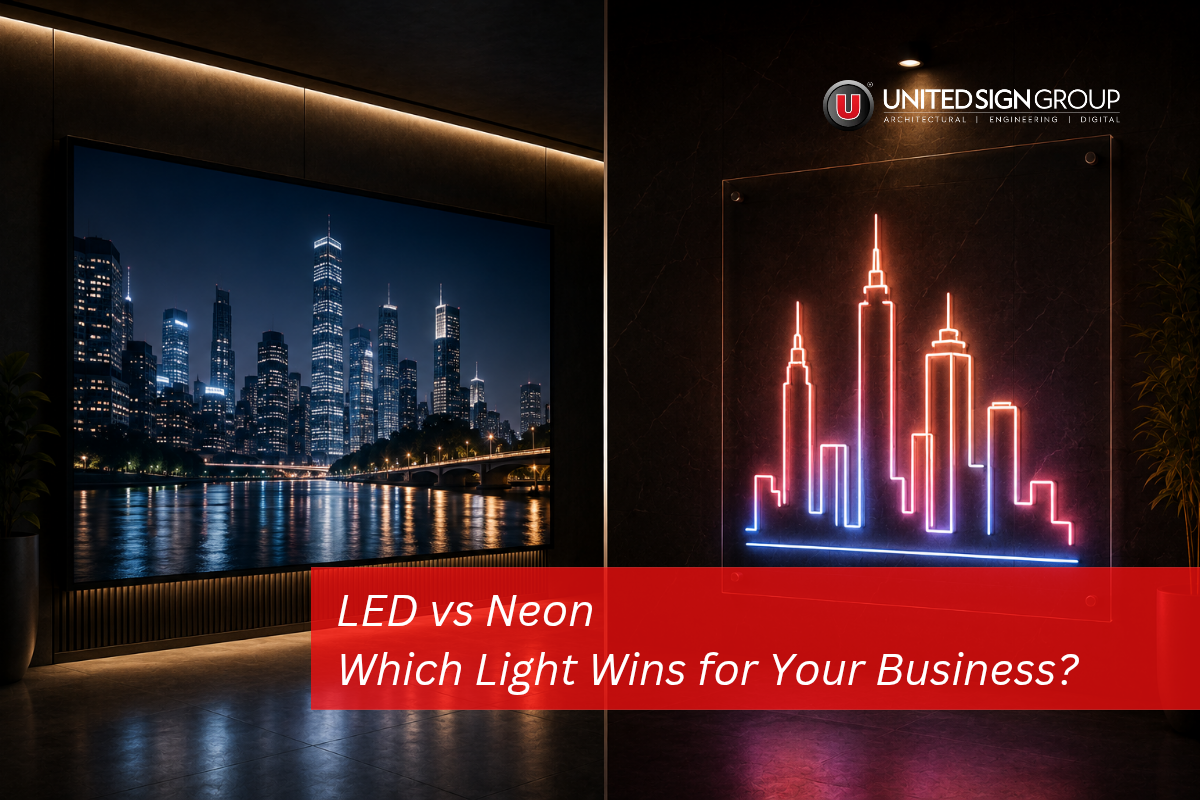
So you’re picking out a sign, and suddenly you’re stuck staring down a question you never expected to care about: LED vs Neon signs (which one actually wins?). And just when you think you’ve narrowed it down, a third contender strolls in: skip the glow altogether and let a beautifully built non-illuminated sign speak for itself. Here’s the thing, this isn’t just a lighting decision. It’s an energy-bill decision, a maintenance-headache decision, and honestly, a personality decision for your brand. Let’s get into it.
LED vs Neon Signs
Let’s not bury the lede: LED wins on paper, and it isn’t close. We’re talking 30,000 to 100,000 hours of life out of a good LED system. Neon? It’s tapping out at 8,000 to 15,000 hours, and that’s before you factor in cracked glass, gas leaks, and Georgia humidity doing its thing. One utility-backed study on channel letters clocked white LED at just 24 watts versus 68 watts for white neon. Do the math on that over a year of 12-hour days, and you’re looking at roughly 210 kWh saved, per sign, per year.
Energy Efficiency LED vs Neon
Here’s where it actually hits your wallet: LED sips up to 75-80% less electricity than neon. Run that math across a storefront lit up 12+ hours a day, every single day, and those savings snowball fast. Most businesses see the higher upfront LED cost pay for itself within a couple of years, and then it’s just money back in your pocket.
Neon Signage Aesthetic
So why does anyone still bother with neon? One word: soul. There’s a warm, hand-blown glow to neon that LED still can’t quite fake, especially up close and indoors. Bars, diners, tattoo studios, boutique shops; they’re not choosing neon by accident. That retro flicker is the brand.
Non-Illuminated Signage

And then there’s the quiet option nobody talks about enough: don’t light it up at all. Non-illuminated dimensional letters are cheaper out the gate, need zero electrical work, and here’s the best part – they simply can’t burn out. Nothing to fail means nothing to fix. Law firms, medical offices, daytime-driven businesses, they gravitate here because it reads as confident and clean, not flashy.
Quick Comparison
| Feature | LED | Neon | Non-Illuminated |
| Average Lifespan | 30,000–100,000 hrs | 8,000–15,000 hrs | Decades (no bulb to fail) |
| Energy Use | (1-5W/ft) | High (3-20W/ft) | None |
| Best For | Storefronts, 24/7 visibility | Retro/vintage branding | Daytime businesses, offices |
| Maintenance | Minimal | Frequent | Virtually none |
| Upfront Cost | Moderate-High | Moderate | Lowest |
Use Case
Let’s take a downtown coffee shop, it opens early, closes late, and a sign glowing the whole time. They went LED, watched their signage energy cost drop by roughly 75%, and haven’t so much as looked at that sign in three years, it just works. Two doors down, a cocktail bar made the opposite call on purpose. They wanted that late-night, hand-blown glow that says “come on in,” chose neon, and happily dealt with a little extra upkeep because the vibe is worth it to them.
Deciding on the Right Sign Lighting
Here’s the honest truth: there’s no universal winner. There’s only the right call for your brand, your hours, and your budget. A 24-hour gym isn’t shopping for the same sign as a boutique law office, and that’s exactly why this is worth talking through with someone who’s actually installed all three.
Not sure which way to go? Speak with our experts at United Signs. We’ll walk you through the real numbers, the maintenance reality, and the look that actually fits who you are before you spend a dollar on the wrong sign.