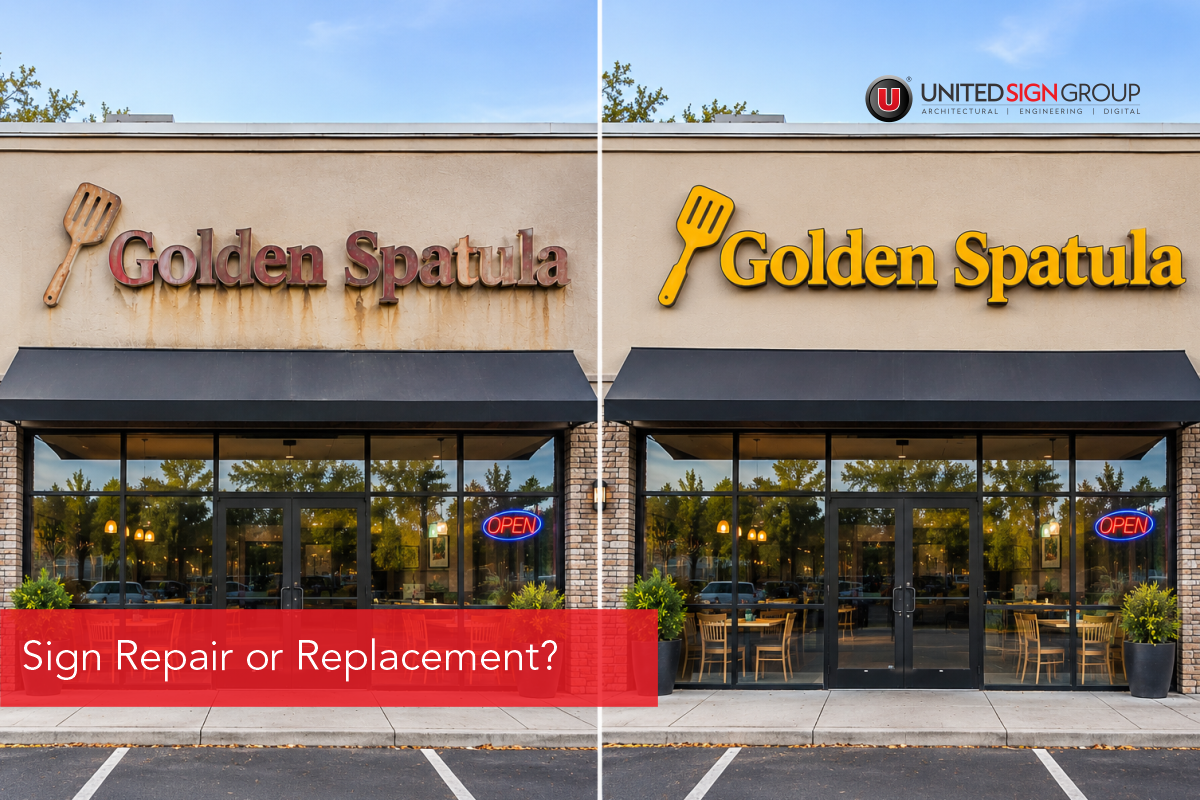
Every business sign wears out eventually. The question is whether it is worth fixing one more time or whether the money is better spent on a new one. Sign repair or replacement is a decision many owners put off, and a sign that looks tired can cost you customers before anyone says a word about it.
In short, this guide covers the warning signs, the real costs on both sides, and a simple way to decide. For that reason, it is written for business owners and facility managers who need a clear answer before they spend anything.
Warning Signs That Call for Sign Repair or Replacement
Some problems are cosmetic. Others, however, point to a sign that has run its course. Look for these:
- Fading or peeling faces. Sun and weather break down paint, vinyl, and plastic over time.
- Dark or flickering sections. Part of the sign is out, or lights blink on and off.
- Cracked or yellowed panels. Older acrylic and plastic turn brittle and discolored.
- Rust or corrosion. For example, stains and flaking on the cabinet or pole suggest the metal is breaking down.
- Water inside the cabinet. Moisture also damages wiring and power supplies.
- Loose or leaning structure. A wobbling pole or a shifting base is a safety problem, not just an appearance one.
- Outdated branding. Old logos, phone numbers, or services make the business look behind.
One of these problems alone does not always mean replacement. However, two or three together usually do.
When Sign Repair Makes Sense
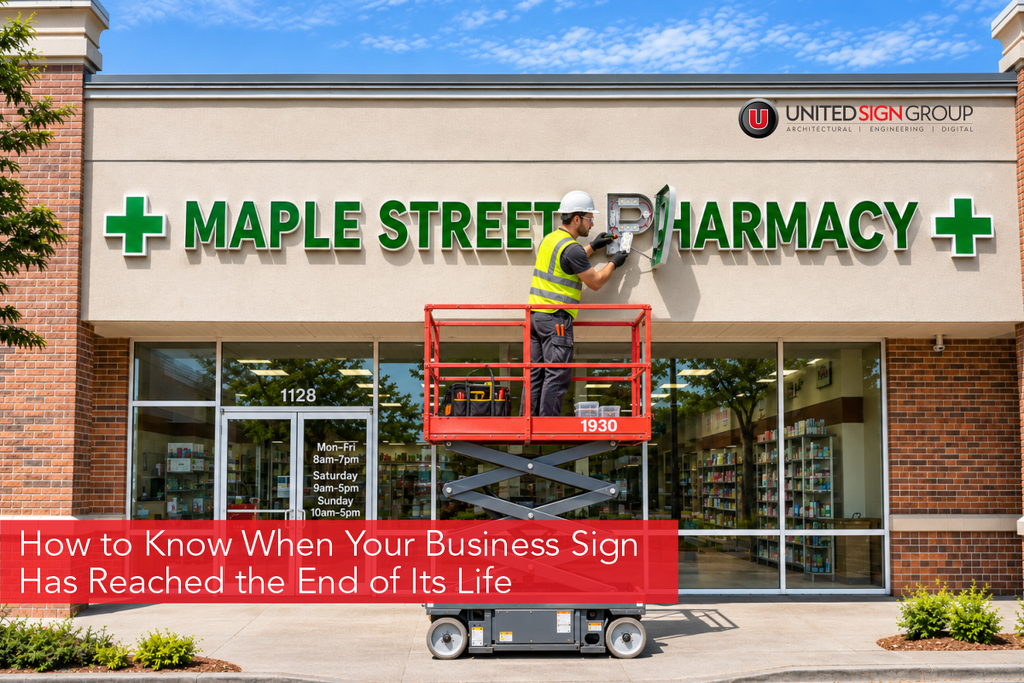
Overall, repair is the right call when the sign is basically sound and the damage is limited. In those cases, fixing it is faster and costs less.
Repair usually works when:
- A few LED modules or a power supply have failed
- The face is damaged, but the cabinet and structure are solid
- The sign is relatively new and still under warranty
- The issue is a loose fastener, a bad connection, or minor weather damage
- Your branding has not changed
In addition, a repair can buy time while you plan a larger project, as long as the structure is safe.
When to Replace a Business Sign
Knowing when to replace a business sign comes down to condition, cost, and what the sign does for your brand. Replacement usually makes sense when:
- Repairs keep repeating. You pay for a fix, and then something else fails a few months later.
- The structure is compromised. For instance, rust, cracks, or a weak foundation put people and property at risk.
- Parts are no longer available. Older sign components can be hard or impossible to source.
- The technology is outdated. Neon or fluorescent systems cost more to run and maintain than LEDs.
- Your brand has changed. A new name, logo, or color palette needs a new face at minimum.
- The sign no longer meets code. Older signs can fall out of compliance with current rules.
Sign Repair or Replacement: A Quick Comparison
| Repair | Replace | |
| Upfront cost | Lower | Higher |
| Long-term cost | Can climb with repeat fixes | Usually lower once new |
| Appearance | Often only partly improved | Fully refreshed |
| Energy use | Unchanged | Often lower with LEDs |
| Warranty | Limited or none | New warranty |
| Best for | Sound signs with isolated damage | Aging signs with repeat or structural problems |
The Real Cost of Outdated Signage
Outdated signage cost is not just the price of the next repair. The sign keeps costing you in less visible ways:
- Lost visibility. A dim or half-lit sign is easy to miss, especially at night.
- Weaker first impressions. Customers judge a business by its storefront. Therefore, a faded sign can suggest a faded business.
- Higher energy bills. Older lighting uses more power than modern LEDs.
- Repeat service calls. Small repairs add up, and each one interrupts your day.
- Safety and liability. A damaged sign that falls or sparks can lead to injury and claims.
- Brand confusion. Old logos and outdated information send the wrong message.
Because these costs spread across months and years, they are easy to overlook. Still, they often exceed the price of a new sign over time.
A Simple Rule for Deciding
No formula fits every sign. Even so, many owners and facility managers use a rule of thumb: if a repair costs roughly half of what a new sign would, replacement is usually the better value. The reasoning is straightforward. You would be spending a large share of a new sign’s price on something that is still old.
To apply it, ask these questions in order:
- Is the structure safe? If not, replace or rebuild before anything else.
- How old is the sign? Signs past 10 to 15 years often have several systems near the end of life.
- How often does it need repair? More than one or two calls a year is a warning.
- Does it still represent your brand? If not, a repair will not fix the real problem.
- What does the repair cost against a new sign? Compare both quotes side by side.
Middle Options Worth Considering
Not every project is all or nothing. In some cases, you can replace part of the sign and keep the rest:
- New face, same cabinet. If the structure is sound, a new face updates the look at lower cost.
- LED retrofit. Swapping old lighting for LED modules cuts energy use and maintenance.
- Refurbish and rebrand. Cleaning, repainting, and updating graphics can extend the life of a solid cabinet.
An assessment will tell you which of these fits. Also, check local sign codes and landlord rules before making changes.
Request a Free Sign Condition Assessment
If you are unsure whether your sign needs a repair or a full replacement, an inspection gives you a clear answer. Our team will review the structure, lighting, and condition, then explain your options with no pressure.
Request a free sign condition assessment or call (800) 935-8094. A specialist responds within 24 hours with a clear next step and no obligation.
FAQs
Lifespan depends on the type, materials, and climate. Many well-built signs serve a business for 10 to 15 years or longer, while harsh weather and poor maintenance shorten that. Regular inspections help you catch problems early.
Repair costs less upfront. However, if the sign needs frequent fixes or has structural problems, replacement often costs less over time. That is why a side-by-side comparison matters.
Lost visibility and a weaker first impression are usually the biggest. A sign that is dim, faded, or partly dark can cost you customers without ever showing up on an invoice.
Often, yes. If the structure is sound, you can replace the face, retrofit LED lighting, or refurbish the cabinet. A condition assessment shows which option fits your sign.