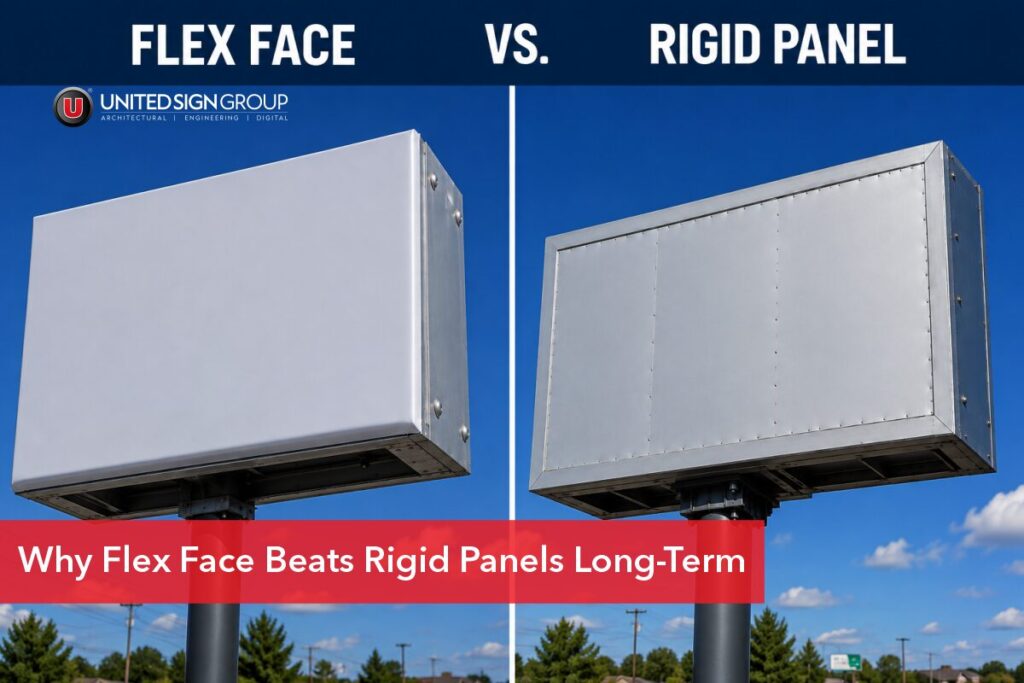
Billboard owners eventually face the same question: stick with rigid panels or move to a flex face system. The material difference sounds minor until you look at what actually happens to each one over years of outdoor exposure. Flex face systems tend to hold up longer, cost less to maintain, and cause fewer headaches along the way. Here’s why.
1. Flex Face Distributes Stress Instead of Fighting It
Rigid panels are solid and unmoving, which sounds like an advantage until wind gets involved. A rigid panel takes wind load head-on, and over years of exposure, that constant pressure works on seams, fasteners, and mounting points. Eventually something gives, whether that’s a cracked panel, a loosened bolt, or a section that starts to warp.
A flex face works differently. Flex face uses the same tension fabric structure principles seen in larger fabric buildings. Crews stretch the material across a tension frame, so it flexes slightly under wind pressure instead of resisting it rigidly. That flex distributes stress across the whole surface rather than concentrating it at fixed points, which is a big part of why flex face structures tend to see fewer wind-related failures over time.
2. Fewer Seams Means Fewer Failure Points
Manufacturers usually can’t make large rigid panels in one piece, so bigger signs end up built from multiple sections joined together. Every seam is a potential weak point where water can get in, materials can shift against each other, and wear shows up first.
Flex face material can cover a much larger area as a single continuous piece. Fewer seams means fewer places for moisture intrusion or material fatigue to start, which adds up over years of weather exposure.
3. The Material Is Built to Resist UV and Weather Directly
Manufacturers build flex face substrates specifically for long-term outdoor use. They use translucent vinyl or fabric that resists tearing, sagging, and UV breakdown. Rigid panels, depending on the material, can be more prone to fading, chalking, or becoming brittle after years of direct sun exposure, especially in high-UV regions.
This doesn’t mean rigid panels fail quickly. It means manufacturers engineer flex face materials with weather resistance as a primary design factor, not a side benefit.
4. Lighter Weight Reduces Structural Wear
A rigid panel at billboard scale is heavy, and that weight puts ongoing stress on the mounting structure and frame itself, especially in high-wind regions. Flex face material is significantly lighter for the same surface area, which reduces the structural load the frame has to carry over the life of the sign.
Less structural stress means less wear on the frame, the mounting hardware, and the foundation supporting the whole sign, which extends the lifespan of the entire structure, not just the face.
5. Replacement Doesn’t Mean Rebuilding
This is less about the material outlasting rigid panels and more about what happens when a face does eventually need replacing. Crews can swap out a damaged or outdated flex face without touching the underlying structure. It ships rolled or flat and installs without specialized equipment.
A rigid panel replacement, especially at large sizes, often means dealing with heavier freight, more complex installation, and sometimes structural modification if the panel doesn’t match the original spec exactly. Flex face keeps the sign’s lifespan tied to the frame, and the frame lasts far longer than any single face material.
Flex Face vs. Rigid Panel: Longevity Factors
| Factor | Flex Face | Rigid Panel |
| Wind stress handling | Flexes and distributes load | Resists rigidly, stress concentrates at fixed points |
| Seams on large signs | Fewer, often a single continuous piece | More seams required at larger sizes |
| UV and weather resistance | Engineered specifically for outdoor durability | Varies by panel material |
| Structural weight | Lighter, less stress on frame | Heavier, more stress on frame and foundation |
| Replacement process | Swappable without touching structure | Often more complex, especially at large sizes |
| Typical use case | Large-format illuminated billboards | Smaller or static installations |
What This Means for Billboard Owners
If you’re managing a flex face billboard that sees years of consistent wind, sun, and weather exposure, the face material isn’t just about how the sign looks. It affects how often you’ll deal with repairs, how the structure holds up over time, and what a face replacement actually costs when it’s needed.
FAQs
It depends on the specific materials and conditions, but manufacturers generally engineer flex face systems to handle wind stress and UV exposure better over time, with fewer seams and less structural load on the frame.
Often, yes, depending on whether the existing structure can support a tension frame system. An evaluation of the current cabinet is the necessary first step.
Yes. Because the material flexes under wind pressure rather than resisting it rigidly, flex face systems tend to distribute stress more evenly, which is an advantage in areas with frequent high winds.
This depends on the substrate quality and local climate conditions, but flex face materials are built for years of outdoor service before replacement is needed.