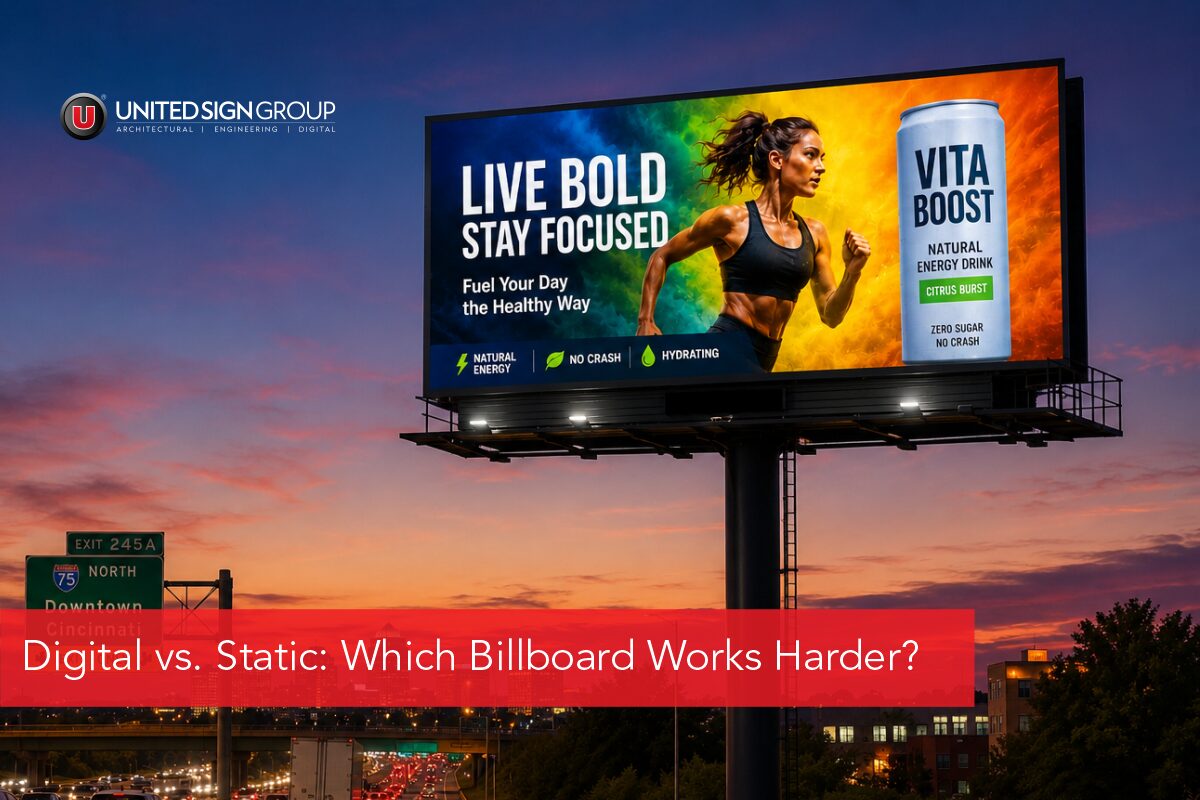
Choosing between a digital billboard and a traditional static one isn’t just a design decision. It’s a budget decision. Let’s discuss Digital vs. Traditional Billboards.
The right choice depends on:
- How long you plan to hold the space
- How often your message needs to change
- How much upfront cost you’re willing to carry
Both formats still work well. The right one depends on how the site will actually be used.
The Core Difference Between Digital vs. Traditional Billboards
A static billboard is printed vinyl or paint, mounted once and left until someone physically swaps it out.
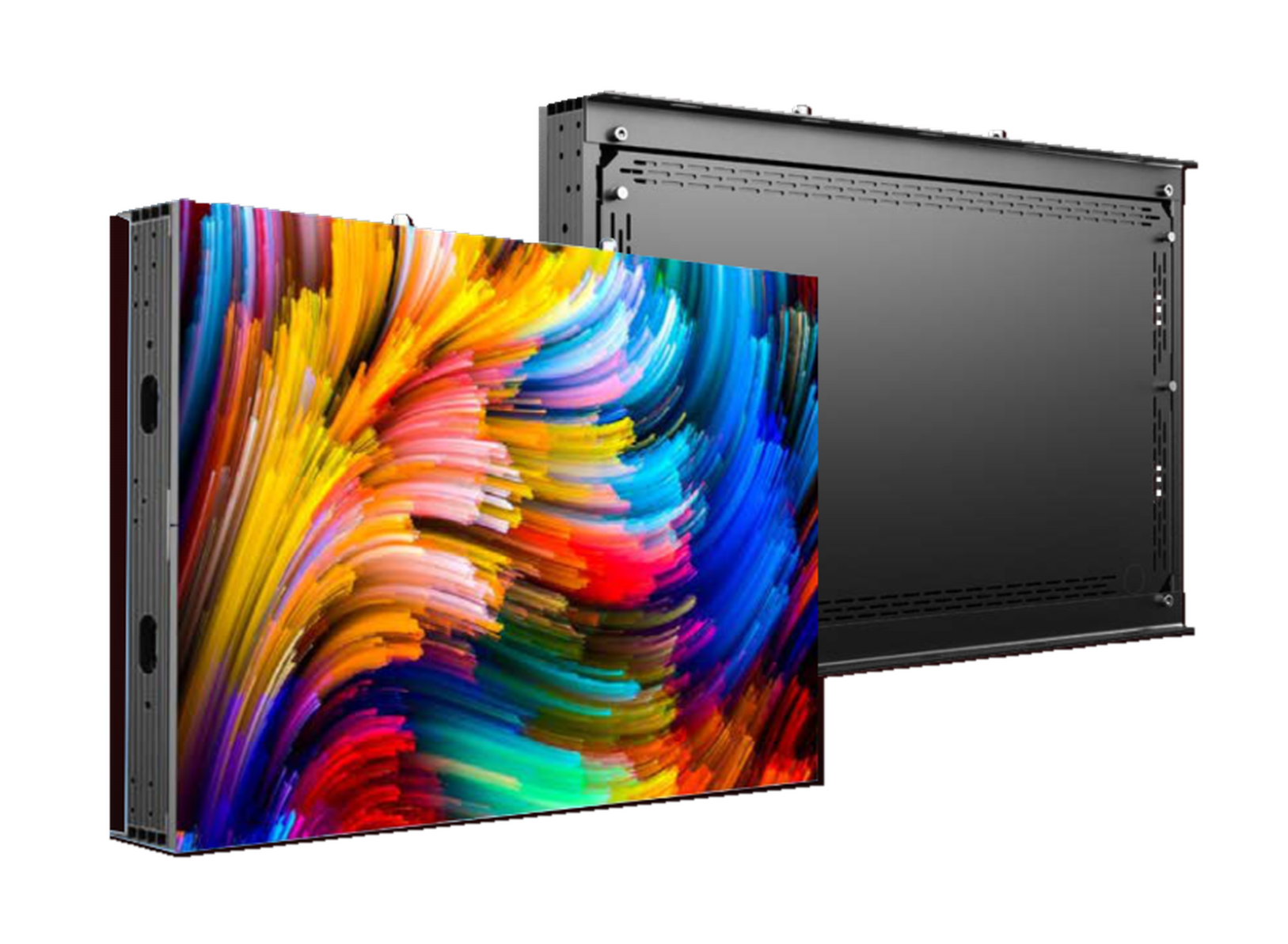
In contrast, a digital billboard uses an LED module that can:
- Display multiple messages
- Rotate advertisers
- Update content remotely, without a site visit
That flexibility is where the cost and value comparison really starts.
Upfront Cost vs. Long-Term Cost of Digital and Traditional Billboards
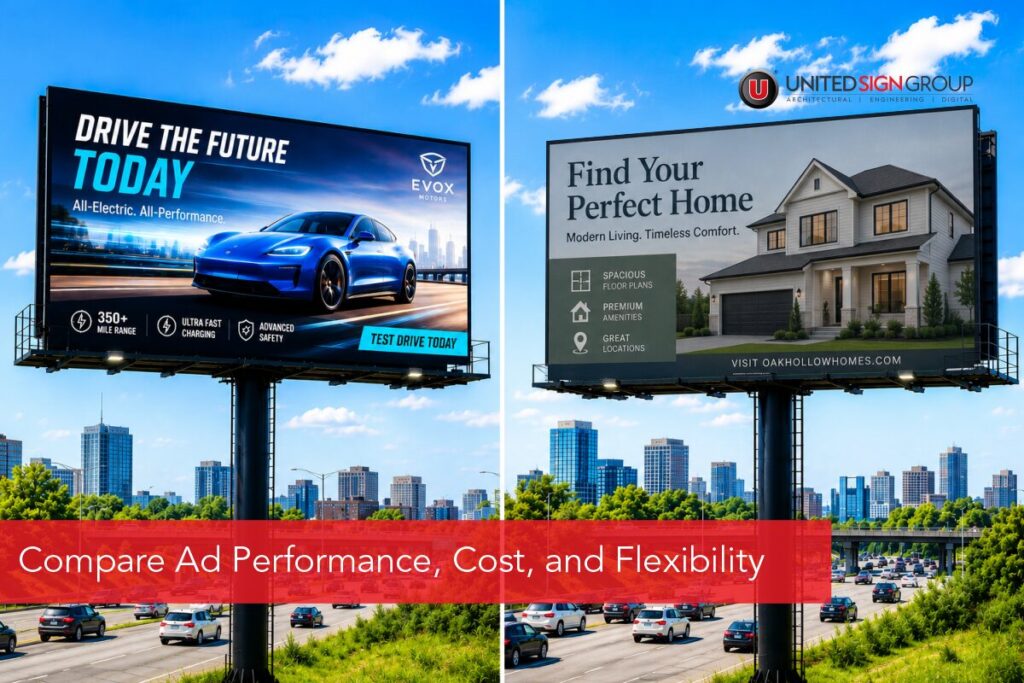
On the other hand, static billboards are cheaper to build. No LED module, no content management software, simpler electrical work.
But every message change means new vinyl production and a physical install. That cost repeats every time.
Digital billboards cost more upfront. For instance, the structure needs:
- A supported LED cabinet
- Wind load engineering for a heavier display
- Power and content management setup
fter construction, updating content is close to free. A new message can go live today, and a different one tomorrow, with no print production and no site visit.
Ad Revenue Potential: Digital Billboards vs. Traditional Billboards
However, this is where digital usually pulls ahead.
- A static billboard sells one ad slot at a time.
- A digital billboard can rotate multiple advertisers on the same structure, adding revenue potential without adding real estate.
For businesses running their own on-premise messaging, this same flexibility means running seasonal promotions or time-sensitive offers without added production cost.
Maintenance and Lifespan in Digital vs. Traditional Billboards
Static billboards:
- Vinyl fades and needs periodic replacement
- Structure needs standard upkeep
- No electronics to maintain
Digital billboards:
- More components overall
- LED modules are typically rated for 100,000+ hours of operation
- That translates to roughly 10 years or more before brightness degrades meaningfully under normal roadside use
Where Static Still Makes Sense
That said, digital isn’t the automatic right answer everywhere. Static may fit better when:
- Local ordinances restrict illuminated or animated signage
- The business needs one long-running message with no plans to change it
- The site sees lower traffic, making the payback period on a digital build too long to justify
Where Digital Makes More Sense
Digital tends to earn back its cost faster when:
- The location sees high traffic
- Multiple advertisers could rotate on one structure
- Messaging needs to update frequently
Additionally, retrofitting an existing static structure with an LED module is also worth considering, since it can add digital flexibility at a lower cost than a full new build.
Side-by-Side Comparison: Digital vs. Traditional Billboards
| Factor | Digital Billboard | Non-Illuminated (Static) Billboard |
| Upfront cost | Higher, due to LED module, structure, and power requirements | Lower, simpler structure and materials |
| Cost per message change | Minimal, updated remotely | Repeats with every new print production and install |
| Ad revenue potential | Multiple advertisers can rotate on one structure | One advertiser per printed face at a time |
| Message flexibility | Can change daily or by schedule | Fixed until physically replaced |
| Typical lifespan | 10+ years before notable brightness loss under normal use | Varies by material, vinyl fades and needs periodic replacement |
| Permitting | Often more involved due to illumination and animation rules | Generally simpler, fewer illumination restrictions |
| Best fit | High-traffic, multi-advertiser, or frequently updated locations | Lower-traffic sites, strict illumination limits, or single long-run messaging |
Permitting Is Part of the Cost Conversation
State and local governments regulate billboard permitting, and varies significantly by location, governed in part by the federal Highway Beautification Act.
Digital billboards often face more scrutiny than static ones, especially around illumination and animation rules. It’s worth confirming what’s actually permittable at a specific site before committing a budget to either format.
A site evaluation that checks traffic counts, zoning, and setback requirements upfront can save a business from designing around a permit that was never going to get approved.
Questions to Ask Before Deciding
- How often will the message realistically need to change?
- Is there enough traffic or advertiser demand to justify multiple rotating ads?
- What do local ordinances allow for illumination and animation at this site?
- Is this a long-term asset the business plans to hold for a decade or more?
- Would retrofitting an existing static structure make more sense than a new build?
Making the Right Call
Ultimately, neither format wins by default.
- A static billboard with one long-running message can be the smarter, lower-cost choice for the right site.
- A digital billboard earns back its higher cost through message flexibility and multi-advertiser revenue, especially in high-traffic spots.
The decision comes down to how the site will actually be used, not which option looks more modern.
FAQs
Upfront, yes. Digital billboards cost more to build due to the LED module, wind load engineering, and power and content management setup. Over time, static billboards can cost more if messaging changes frequently, since each change means new production and installation.
Outdoor LED modules are typically rated for 100,000+ hours of operation, which translates to roughly 10 years or more before brightness degrades meaningfully under normal roadside conditions.
In most cases, yes. Retrofit conversions depend on the condition of the existing structure, the pole rating, and local permit requirements, so the existing installation needs to be evaluated before quoting a conversion.
Yes. A digital billboard can rotate multiple advertisers on the same structure, which is one of the main ways it can generate more revenue potential than a static billboard selling a single ad slot.