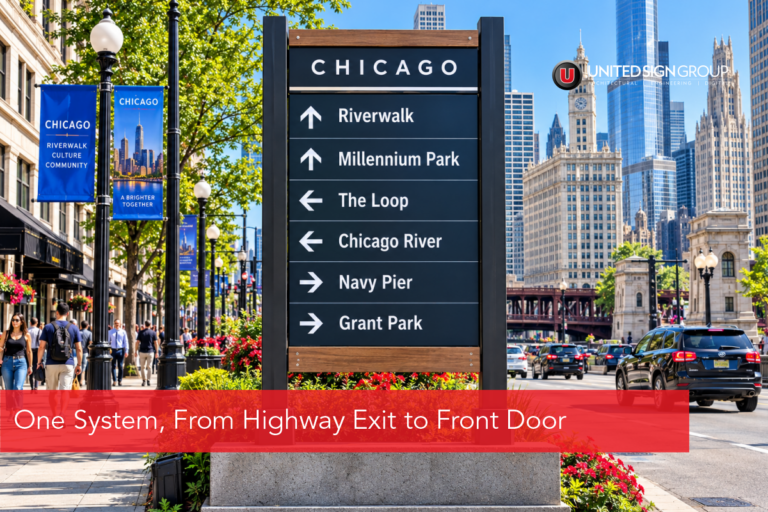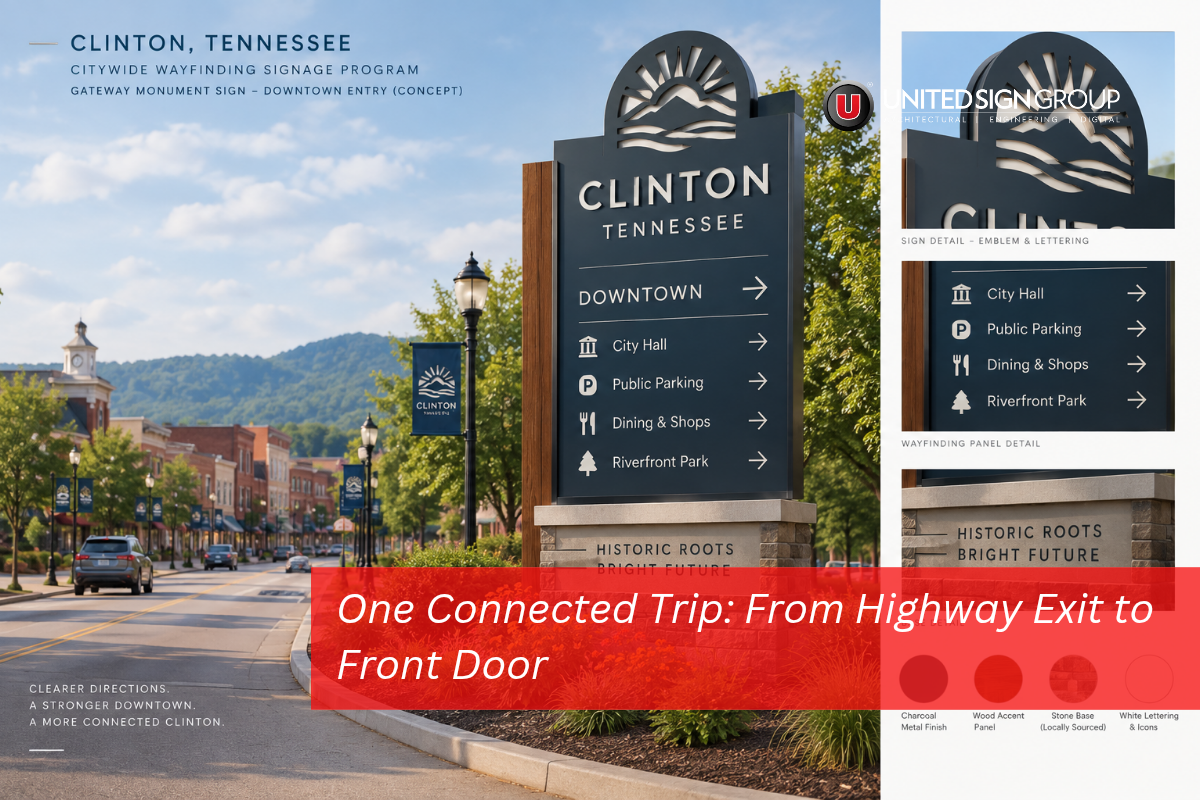
A city doesn’t lose visitors in one dramatic wrong turn. It loses them in small moments: a missed exit, an unclear intersection, a parking lot nobody marked. Citywide wayfinding signage exists to close those small gaps before a visitor gives up and drives somewhere else.
United Signs has proposed a citywide wayfinding signage program built around that exact chain of moments, from highway exit to downtown to parking to front door, for Clinton, Tennessee. The plan is still a preliminary, budgetary proposal. Nothing here is a signed contract. Locations, sign counts, and final design details all depend on a field survey and city approval first.
What a Citywide Wayfinding Signage Program Actually Covers
Municipal wayfinding isn’t one sign type. It’s a hierarchy, and Clinton’s proposed citywide wayfinding signage program splits into four tiers. Gateway and district signage would orient visitors the moment they enter Clinton or Historic Downtown. Civic and cultural signage would point toward City Hall, the Anderson County Courthouse, and the Green McAdoo Cultural Center. Recreation signage would guide people to parks like Lakefront Park and Jaycee Park. Arrival and pedestrian signage would close the loop: public parking, downtown shopping, walking-tour connections.
Four priorities sit behind that structure. Place signs only where a visitor could actually lose the route. Build a sign family that reflects Clinton’s historic character. Send drivers to parking before they reach a final destination. Design the system so it can grow later, without a full redesign.
Inside the Proposed Citywide Wayfinding Signage Program
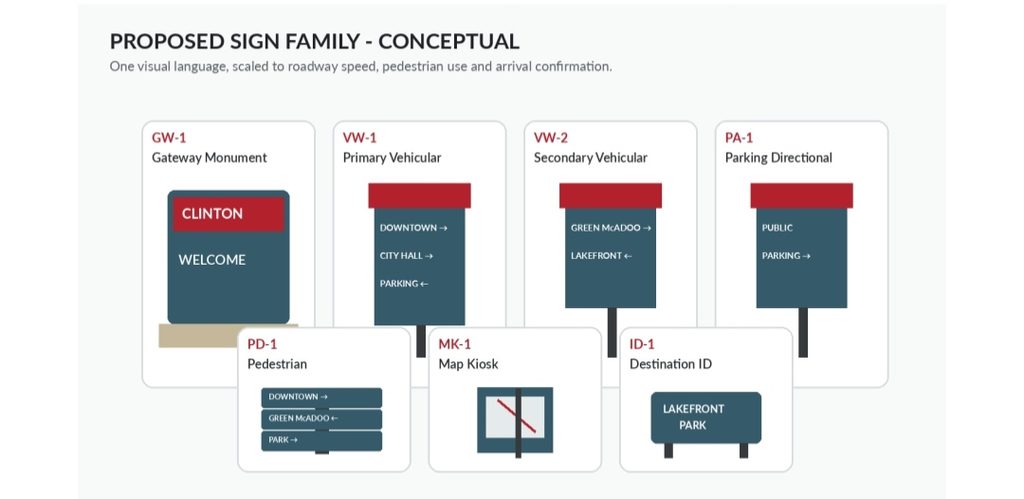
The preliminary plan covers 55 sign locations across seven coordinated sign types. A field survey could still shift those numbers once it confirms exact placement and site ownership.
The Citywide Wayfinding Signage Family: Built for Drivers and Pedestrians
Gateway monuments would mark the big entrances into Clinton. Primary vehicular signs would carry drivers through multi-destination roadway guidance, while secondary vehicular signs would handle the final approach into a specific destination. Parking directional signs would take over once a driver gets close to downtown. Pedestrian directional signs would guide people on foot from there, through the walking network. Map kiosks would give visitors one clear orientation point, and destination identification signs would confirm arrival at parks and civic sites. Every count stays preliminary until the field survey locks it in.
The Routing: Built Around Real Decision Points
Good routing doesn’t start with a sign. It starts with a visitor’s actual journey and who owns the road beneath their feet. The proposed spine runs from the I-75 / Exit 122 approach through Charles G. Seivers Boulevard, into Historic Downtown, past civic destinations, and on to Green McAdoo, Lakefront Park, and public parking.
Six field survey deliverables would ground that routing before any sign design locks in. First, an inventory of existing signage. Second, a documented list of every point where a visitor could lose the route. Third, an ownership classification for each site: city, county, TDOT, or other right-of-way. Fourth, a record of site constraints like sight distance and utilities. Fifth, an approved message schedule for destination names and arrows. Sixth, a permanent asset database, assigning each sign a unique ID such as CL-VW-001, tied to GPS coordinates and a replacement spec.
In Two Layers: Vehicles, Then Pedestrians
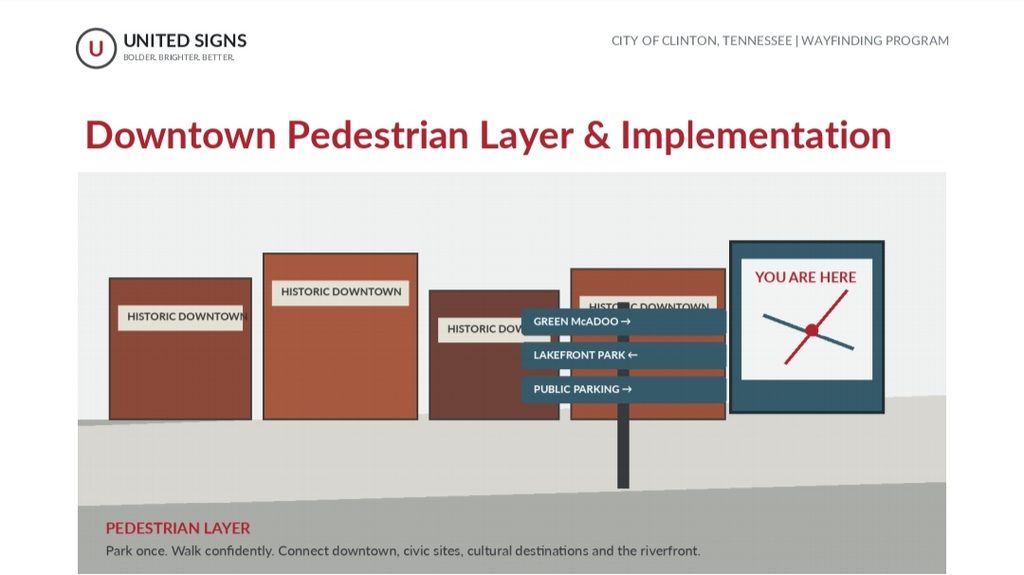
Once a visitor parks, the plan hands the job to a pedestrian layer. Pedestrian blades and map kiosks would connect Market, Main, and Broad Street to City Hall, the courthouse, Green McAdoo, the library, Lakefront Park, public parking, and existing historic-tour connections. Park once. Walk confidently. Let the signs carry the rest of the trip.
Why Design-Build Fits This Signage Proposal
Municipal signage answers to more regulators than almost any private project ever does. Any sign inside a state right-of-way needs early coordination with TDOT. Roadway signage also needs to line up with the Federal Highway Administration’s Manual on Uniform Traffic Control Devices, the current 11th Edition with Revision 1, the federal standard behind traffic and directional signage design. Tennessee’s own TDOT Traffic Design Division resources sit on top of that, adding state-specific requirements.
One team handling all of it early avoids a costly redo later. A separate designer finishing drawings before a state agency ever reviews them is exactly how projects stall. The proposal also calls for a prototype phase first: one full-size vehicular sign and one pedestrian element, tested in the field for legibility, contrast, mounting height, nighttime reflectivity, and overall community character. That step catches a flaw once, instead of fabricating it dozens of times over.
The system also plans for its own future. A permanent asset-numbering structure and modular panels mean new destinations could join later, without tearing the whole program apart to fit them in.
United Signs points to more decades in the signage industry, 26 locations listed on its own site, and over 10,000 projects shown across its portfolio, according to the company’s own materials. That kind of track record matters most exactly here. A program this regulatory-heavy needs a team that’s navigated TDOT and MUTCD requirements before, not for the first time.
Before Citywide Wayfinding Signage Goes Into Production
Nobody has fabricated or installed anything yet. The full plan maps out roughly 34 weeks from notice to proceed: survey, routing, design, review, engineering, documentation, prototype, fabrication, and install, back to back.
The real next step is smaller than the full build-out. It’s authorizing Phase 1: completing the field survey, the destination hierarchy, the route plan, the message schedule, and a conceptual sign family. Only after that phase closes would United Signs come back with a confirmed sign count, a site-specific placement plan, a preliminary engineering review, and a refined proposal for fabrication and installation.
Want a fuller picture of how this delivery model works? Read our breakdown of design-build signage, or see how the same model applies to a completely different setting in our piece on interior wayfinding for a VA medical center.
Citywide Wayfinding Signage: Frequently Asked Questions
It’s a coordinated system of gateway, directional, pedestrian, and destination signs that carry a visitor from a city’s main approaches to its downtown, parks, and parking: one connected trip, not scattered signs.
Citywide programs guide both drivers and pedestrians across an entire municipality. Interior wayfinding stays inside one building. Citywide signage also answers to roadway and right-of-way rules that interior signs never face.
Any sign near a public roadway or inside a state right-of-way has to meet federal MUTCD standards. Coordinating early stops a state agency from forcing a redesign after the fact.
A gateway sign marks entry and confirms a visitor has reached the right area. A directional sign gives an active instruction, like which way to turn or which exit to take, right at the decision point.
Let’s Talk Citywide Wayfinding Signage for Your City
Municipal wayfinding pulls in more stakeholders than most signage projects ever will: city departments, county roads, state right-of-way, and every visitor trying to find their way through all of it. If your city needs one team to run the survey, the design, and the regulatory approvals together, request a quote from United Signs. The first step is always a field survey, before a single sign gets recommended.