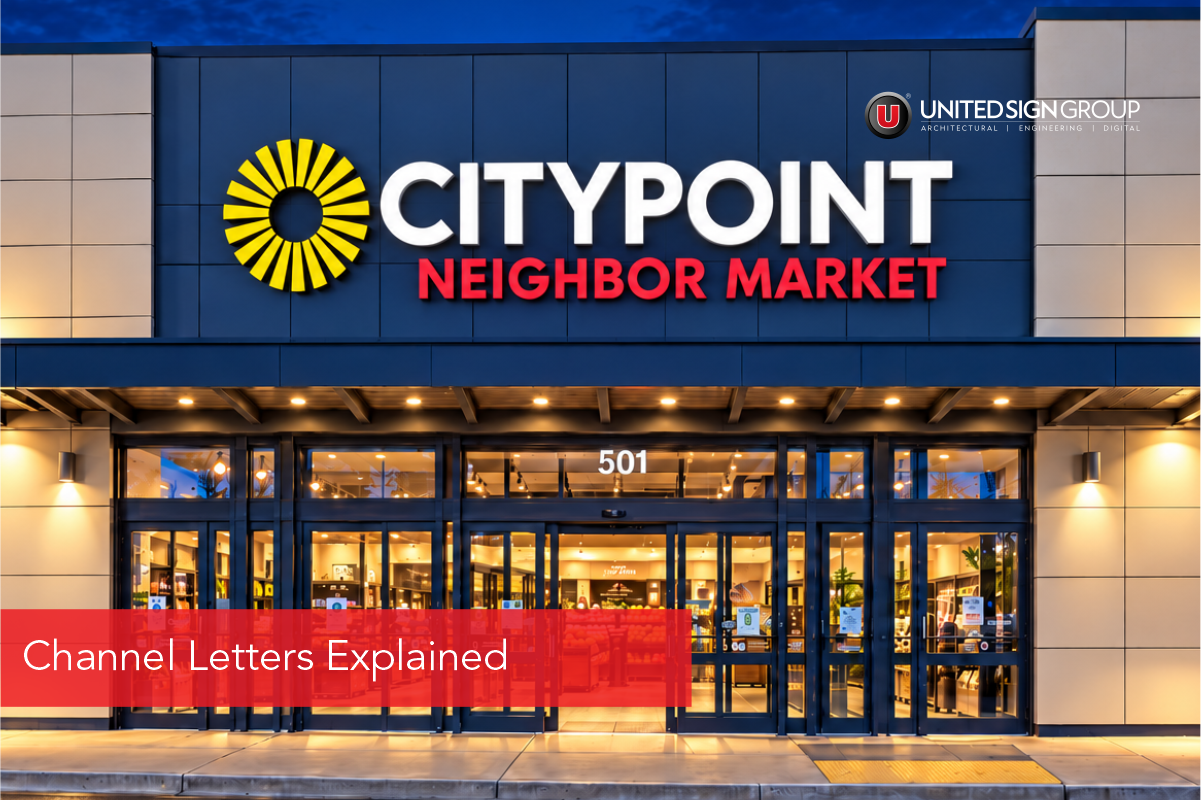
Channel letters are the 3D, individually lit letters you see on most storefronts, from retail strips to banks to restaurants. If you are planning a sign for your building, the first decision is which style to go with. The types of channel letters look different at night, read differently from the road, and carry different price tags.
Below, you will find how each style works, who it suits, and what to check before you ask for a quote.
How Channel Letters Are Built
Each letter is a hollow aluminum shell. The front is called the face, and the sides are called returns.Inside, LED modules light the letter. Because every letter is made and mounted on its own, you can place a name on almost any wall, with or without a backing panel.
So the real difference between styles comes down to one thing: where the light goes.
The Main Types of Channel Letters
- Front-lit: light shines through the face
- Halo-lit: light shines onto the wall behind the letter
- Reverse channel: the construction that creates the halo effect
- Combination: front and halo lighting on the same letter
Front-Lit Channel Letters
The face is translucent acrylic, and the LEDs shine straight through it. As a result, whatever color the face is, that is what people see at night.
Works well for:
- Businesses on busy roads, since drivers need to read the name early
- Brands with bold colors that should stay vivid after dark
- Storefronts in crowded strip centers, where visibility matters most
Keep in mind:
- It is the most common style, so landlords and city reviewers know it well.
- The lit face also stays readable in daylight.
- Fabrication is simpler than halo-lit, which is why the price is often lower.
Halo-Lit Channel Letters
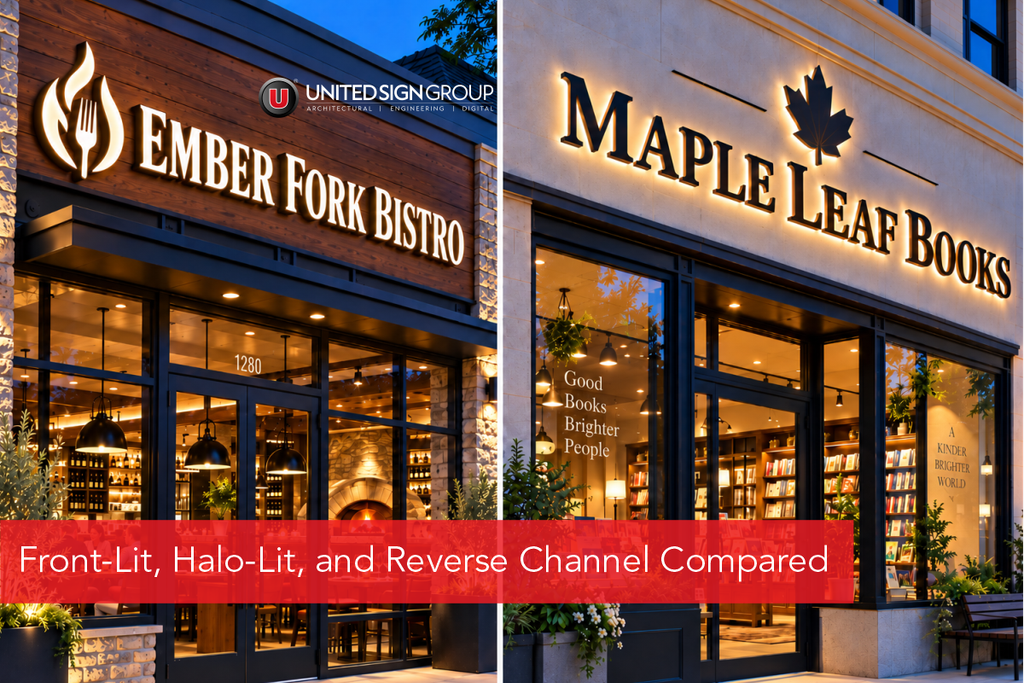
The face is solid, so no light comes through the front. Instead, the LEDs point backward, and the light spreads across the wall behind each letter as a soft ring. Halo lit channel letters have a quieter, more polished look. For that reason, hotels, boutiques, medical offices, and law firms use them often.
Works well for:
- Brands that want a premium, understated look
- Buildings with a smooth, light-colored wall
- Locations where you want soft light instead of a bright face
Keep in mind:
- Letters sit an inch or two off the wall, so the light has room to spread.
- However, dark or rough walls soak up the glow and weaken the effect.
- Also, in strong daylight or from far away, the halo is harder to notice.
Reverse Channel Letters
People often ask how reverse channel differs from halo-lit. In most shops it does not. “Reverse channel” refers to the build, which has an open back, a solid face, and LEDs aimed at the wall. Halo-lit, on the other hand, refers to the glow that build produces.
Therefore, if two companies quote you using different names, ask each to confirm the construction and how the letters mount. Otherwise, you may end up comparing the same product without realizing it.
Combination Lighting
Some projects use both methods. The face lights up, and the wall behind it glows too. Naturally, this costs more and takes longer to build. Still, it suits flagship locations that need to stand out in more than one way.
Side-by-Side Comparison
| Front-Lit | Halo-Lit / Reverse | |
|---|---|---|
| Light direction | Through the face | Onto the wall behind |
| Look | Bold and bright | Soft and refined |
| Readability from a distance | Strong | Moderate |
| Wall requirements | Flexible | Needs a surface that reflects light |
| Mounting | Flush or on a raceway | Standoff from the wall |
| Common users | Retail, restaurants, services | Hospitality, offices, boutiques |
Why Most Channel Letters Use LEDs
Nearly all new LED channel letters have replaced neon, and the reasons are practical:
- Lower power use. LEDs draw much less electricity, so your monthly bill stays lower.
- Less upkeep. There are no glass tubes to crack and no high-voltage transformers to swap out.
- Even light. Modern modules fill the whole face without dark spots.
- Color range. White and full-color options also match most brand palettes.
- Weather tolerance. In addition, modules handle sun, rain, and temperature changes.
When you compare quotes, ask which LED modules are used. Likewise, check whether the power supplies are rated for outdoor use and what the warranty covers.
How to Choose Between the Types of Channel Letters
Work through these five questions in order:
- How far away do people need to read it? If your sign faces road traffic, front-lit is usually the better fit.
- What should the sign say about your brand? For a premium feel, halo-lit works better.
- What is your wall made of? Since halo-lit depends on reflection, it needs a surface that shows the glow.
- What do your lease and city allow? Sign codes and landlord rules can limit size, lighting, and mounting.
- What is your budget? Front-lit usually costs less, while halo-lit and combination styles add fabrication work.
Finally, seeing a mockup on a photo of your own building usually settles the question quickly.
What to Ask Before You Order
- Is this quote for front-lit, halo-lit, or a combination?
- What are the return depth and material?
- Will the letters mount flush, on a raceway, or on standoffs?
- Who handles the permit and landlord approval?
- Is the installer licensed in my area?
- What does the warranty cover, and for how long?
Request a Channel Letter Quote
You do not need to decide between the types of channel letters before you reach out. Send us photos of your storefront, your brand colors, and your location, and the United Signs team will help you compare front-lit, halo-lit, and combination options for your building.
Request a channel letter quote or call (800) 935-8094. A specialist responds within 24 hours with a clear next step and no obligation.
You can also browse our channel letters capabilities to see what we build.
FAQs
Front-lit letters have a translucent face, so light passes through the front toward the viewer. Halo-lit letters, in contrast, have a solid face, and the LEDs shine backward onto the wall to create a soft glow around each letter. As a result, front-lit is brighter and easier to read from far away. Halo-lit looks more refined, but it works best on a wall that reflects light well.
In most cases, yes. Reverse channel describes the build, with an open back, a solid face, and LEDs aimed at the wall. Halo-lit describes the glow that build creates. Sign companies use both terms for the same product, so confirm the construction and mounting method when you compare quotes.
For most businesses, yes. LED channel letters use less energy, need less maintenance, and hold up well outdoors. They have no glass tubes to break and no high-voltage transformers to replace. Neon still appears in some vintage designs, but LED is the standard for new channel letter signs.
It depends on your location and brand. Front-lit letters suit retail stores on busy roads because they stay readable from a distance and show brand colors clearly at night. Halo-lit letters suit boutiques, salons, and professional offices that want a more upscale look. If you are not sure, send storefront photos and a sign company can show you a mockup of each option.