Outdoor LED total cost of ownership comes down to a handful of real numbers, and most quotes hide every one of them. Here are the ones we’d put on the table first:
22.09 W vs. 31.45 W
In a 2022 test published by LEDinside, driver-chip maker Chipone measured a common-cathode module at 22.09 W and a common-anode module with the same specs at 31.45 W. That’s about 30% less power. The lamp surface also ran 12.4°C cooler. It’s the chip vendor’s own test, so read it as evidence for the design approach rather than as a promise for any one sign.
100,000 hours
That’s the rated LED life on the US-Genesis II spec sheet, about 11.4 years of nonstop running on paper. The spec sheet doesn’t say what brightness that rating assumes, so ask any vendor to state it.
18 W per square foot
That’s Genesis II’s rated average draw at 6.67mm to 10mm SMD. The maximum is 56 W.$276 per service call, in 2009. A 2009 Aberdeen Group study, as cited by Dataprobe, put the average on-site service call at that figure. Today’s cost will differ, but it shows the scale of one truck roll before anyone touches the sign.
Now the part nobody likes to say out loud. The purchase price is the smallest decision you’ll make about this sign. The rest of the bill shows up later, quietly, and it’s usually bigger than people expect.
Why the Cheapest Quote Often Costs the Most
Let’s take two quotes for the same sign. One comes in lower, so it wins. A few years later, that buyer is paying more for electricity, calling a technician every time a storm rolls through, and wondering why the cabinet looks tired.
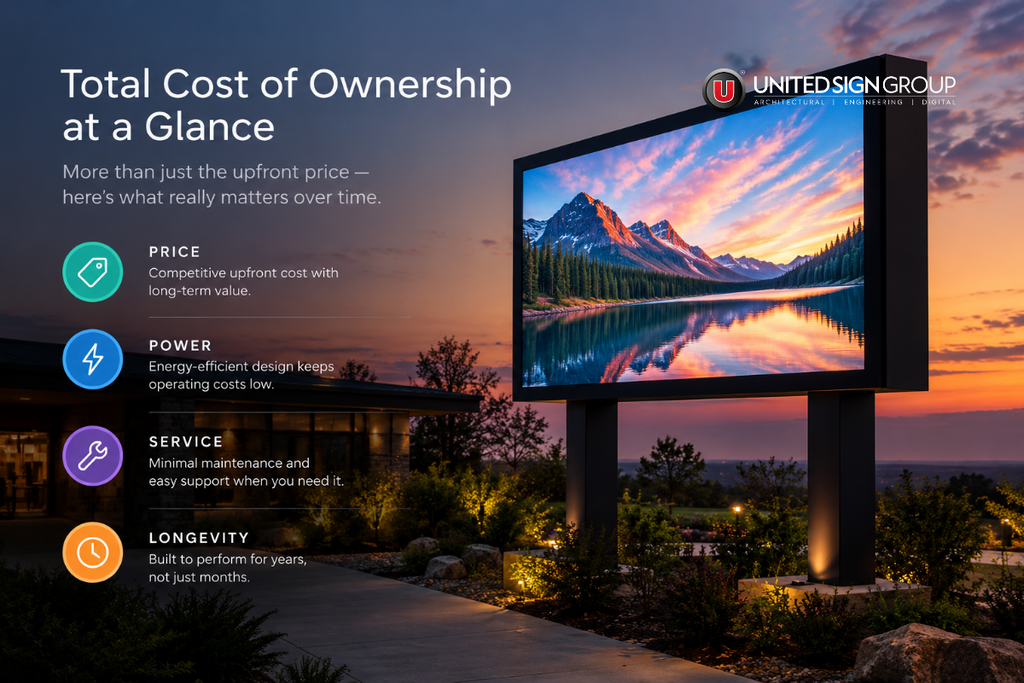
The fix takes one spreadsheet. Split every quote into four bills:
| Bill | What drives it | What to look for |
| Price | Size, pixel pitch, install | What’s included: software, training, support |
| Power | Hours on, watts per square foot | Average and maximum draw, driver design |
| Service | Access, parts, downtime | Front or rear access, quick-release parts, monitoring |
| Longevity | Weather, heat, LED life | IP rating, cabinet material, rated lifespan |
Most buyers compare row one and stop. Rows two through four decide what year five looks like.
The Power Bill Never Takes a Day Off
A sign draws electricity every hour it’s lit, so small efficiency gaps pile up fast.
Try this on a 100-square-foot screen. At 18 W per square foot, that’s 1.8 kW. Running nonstop, it uses about 15,768 kWh a year. At an assumed 12 cents per kWh, you pay roughly $1,892 a year, or about $18,900 over ten years. That rate is our placeholder, not a measured price, so plug in your own from the U.S. EIA’s electricity data and your real operating hours. A sign showing typical content may also run below its rated average, which only helps you.
Genesis II uses common-cathode technology and power supplies rated at 90% efficiency or better. We don’t publish a measured savings percentage for the product, so ask any vendor, us included, for measured draw on your exact configuration.
What an IP-Rated Cabinet Saves You
Water and heat destroy outdoor electronics, and both land on your service bill.
An IP65 rating means the enclosure is dust-tight and withstands water jets from a nozzle, aimed from any direction, under the IEC 60529 standard. Genesis II carries it, with an aluminum cabinet and module components sealed in silicone gel on both sides. It’s rated from -40°F to +140°F.
Heat gets handled in layers. Common-cathode design runs cooler to start with. Fans kick in at 40°C (104°F) and run until the cabinet drops back to 35°C (95°F), and you can adjust that through software. The power supply has no fans, so salt air, dust, and condensation never get pulled across it. Fewer exposed moving parts means fewer repairs.
Service Access Is a Cost, Too
Every outdoor sign breaks eventually. The design decides what that costs you.
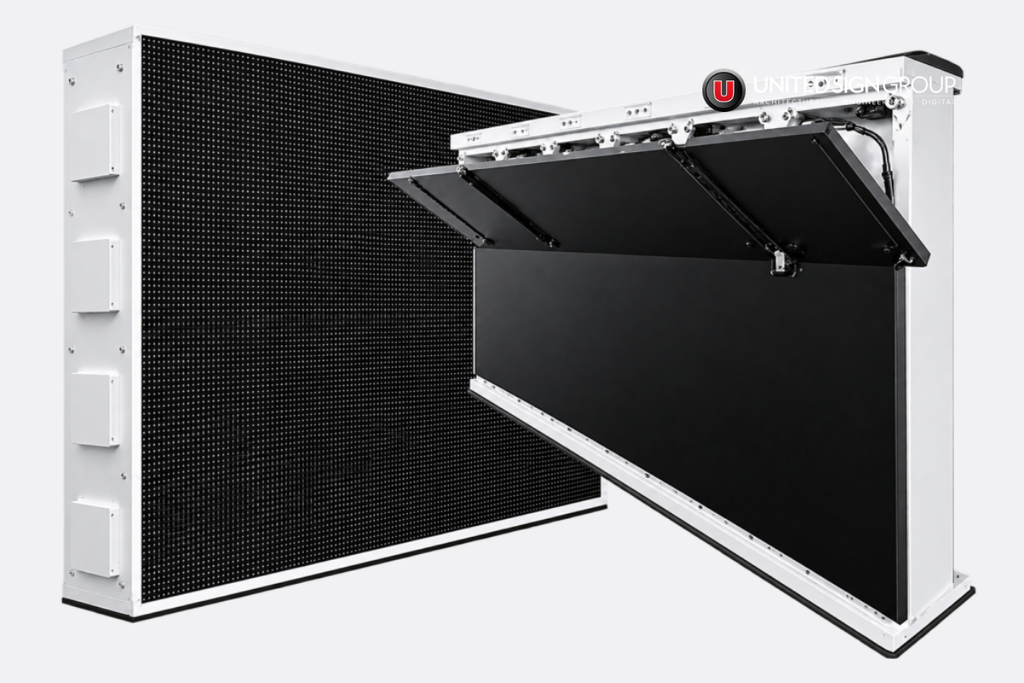
Genesis II services from the front as standard, with rear-access doors available as an option. Modules have built-in handles, safety cables, and alignment pins, and connectors release quickly. A technician can swap a module without tearing the sign apart.
Also, monitoring covers the other expense, which is the surprise. Cloud monitoring on Genesis II is optional. When you add it, it tracks power supplies, cooling fans, and LED modules down to individual diodes, then sends alerts and supports remote troubleshooting.
Separately, United Signs lists lifetime support, Viplex software, and subscription-free cloud access among its benefits. Because monitoring is optional, confirm in writing exactly what your quote includes.
Quick Answers on Outdoor LED Total Cost of Ownership
Everything you pay across the display’s life: purchase, installation, electricity, service, parts, downtime, and replacement.
A lot, because the sign runs for years. At 18 W per square foot, a 100-square-foot screen uses about 15,768 kWh annually if it never turns off.
It can. IP65 keeps dust and water jets out of the electronics, so weather causes fewer failures and fewer repair bills.
Yes. Both carry price, power, service, and longevity costs, and bigger screens multiply each one. See our digital billboards for large-format options.
Average and maximum power draw, service access, monitoring terms, warranty details, and support. If a quote skips one, ask.
Five Questions for Every Quote
Hand these to every vendor, including us.
- What are the average and maximum watts per square foot at my pixel pitch?
- What’s the IP rating, and what’s the cabinet made of?
- Does service happen from the front, the rear, or both?
- Is remote monitoring included or optional?
- What do the parts warranty and support terms cover, and for how long? And at what brightness is the LED lifespan rated?
Still choosing a pixel pitch? Our LED basics guide and pixel pitch guide walk through it, and our financing options help if budget drives the decision.
Get a TCO-Focused Quote
A good quote shows you ten years, not one invoice. Tell us about your site, your hours, and your power rate, and we’ll price Genesis II with power, service, monitoring, and support listed line by line. You compare real numbers. Get a TCO-focused quote and see what this display costs to own.