An LED sign ordinance can shut down a display long before anyone files a complaint about it. Dark-sky and brightness regulations now shape how bright a sign can run. They also decide when it has to dim and what hours it can stay lit. Understanding these rules before installation avoids a compliance problem down the line.
What an LED Sign Ordinance Actually Regulates
Most LED sign ordinances cover three core areas: brightness limits, dimming requirements, and operating curfews. Local governments set these rules to reduce light pollution, glare, and nighttime light trespass onto neighboring properties, while still letting businesses use illuminated signage effectively.
Brightness gets measured in nits, candelas per square meter, which describes the sign’s surface luminance. This is different from foot-candles, which measure how much light the sign casts onto surrounding areas. Local codes often regulate both separately, so a sign can comply with one standard and still violate the other.
LED Sign Ordinance Nit Limits and Zoning Classifications
Many ordinances set brightness limits based on zoning classification rather than a single citywide number. A common framework splits areas into lighting zones: rural zones generally cap brightness around 20 nits, suburban zones around 40 nits, and high-ambient commercial zones up to 160 nits or more. As a result, the same sign design might comply in a busy commercial corridor and violate the code just a few blocks away in a quieter zone.
Nighttime limits run much lower than daytime limits across nearly every ordinance type. Daytime luminance often exceeds 5,000 nits to stay visible against bright ambient light, while nighttime caps frequently drop to 100 nits or less under dark-sky-aligned codes.
Auto-Dimming Requirements in an LED Sign Ordinance
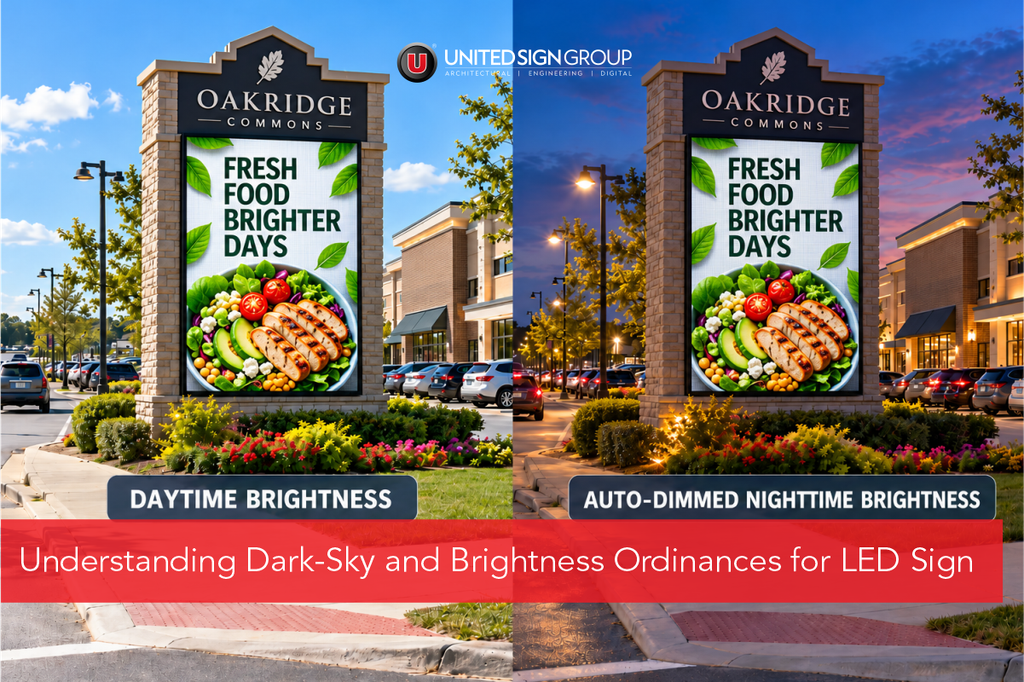
Automatic dimming has become a standard requirement, not an optional feature. Because ambient light drops significantly after sunset, a sign running at daytime brightness after dark creates glare and violates most modern ordinances outright.
Manual brightness adjustment typically doesn’t satisfy compliance requirements anymore. Automated controls, whether time-based, photocell-triggered, or networked, are increasingly required specifically because manual switches get forgotten or ignored. A sign that can’t automatically scale its brightness to ambient conditions is at real risk of falling out of compliance after installation.
Curfew Rules and Operating Hours
Curfew requirements shut signs off, or reduce them to minimal brightness, during specific overnight hours. A common curfew pattern switches electronic message centers off entirely around 11 p.m., or 30 minutes after business close for on-premise signs, whichever comes later, remaining off until roughly an hour before sunrise.
Some jurisdictions take a lighter approach, requiring dimming to 30 to 50 percent of daytime brightness after hours rather than a full shutoff. Either way, curfew compliance now generally requires automated scheduling built into the sign’s control system from day one.
A Practical Compliance Checklist
- Confirm your local lighting zone classification. Brightness limits often shift significantly between zoning types.
- Separate nit limits from foot-candle limits. Your sign may need to meet both standards independently.
- Verify your display includes automatic dimming. Manual adjustment alone rarely satisfies current requirements.
- Check your jurisdiction’s curfew schedule. Full shutoff and partial dimming are both common approaches, and the required hours vary by location.
- Confirm color temperature requirements if applicable. Some ordinances now specify warmer color temperatures, often around 3000K, to reduce glare and ecological disruption.
- Keep manufacturer brightness documentation on file. Permitting reviewers often request this during the approval process.
Why This Matters for Sign Owners
A non-compliant display risks more than a warning letter. Repeat violations can lead to fines, forced shutoffs, or required retrofits that cost far more than building compliance in from the start. Because LED sign ordinances increasingly tie into broader dark-sky policy, this trend shows no sign of slowing down in new municipal codes.
Building Compliance In From the Start
Choosing a display with built-in automatic dimming, programmable curfew scheduling, and documented brightness specifications makes clearing local review significantly easier. A sign engineered around these requirements from the design stage avoids the retrofit costs that come with addressing compliance after installation.
If you’re planning a new LED display and want to understand what your local ordinance actually requires, it’s worth a conversation with a signage specialist before finalizing your design.
Enjoyed This? You Might Also Like: How Digital Billboards Let You Advertise in Real Time
FAQs
Nits measure a sign’s surface brightness, while foot-candles measure how much additional light the sign casts onto the surrounding area. Many ordinances regulate both separately.
Increasingly, yes. Most current ordinances require automated brightness controls rather than manual adjustment, since manual systems are easy to forget or ignore after installation.
This varies by jurisdiction, but many ordinances set curfews around 11 p.m. or 30 minutes after business close, whichever is later, with signs remaining off until about an hour before sunrise.
Warmer color temperatures, often around 3000K, cause less glare and less disruption to wildlife and circadian rhythms than cooler, bluer light, which is why some dark-sky-aligned ordinances now require it.