Walk up to an LED display and you can see the viewing angle spec. The colors will transition from true to false, and the display will appear to be dimmed. Now imagine someone is standing dead center. The room will look great. But people can’t stand dead center. Users will approach a display from several different directions.
Why Viewing Angles Are Important
LED displays should be mounted to provide a good line of sight for the majority of users. This is especially true if the display is mounted to divide a space. If the viewing angles are good, a designer can ignore the display when planning a space. People sitting at the edge of the viewing angle will not say the angle is wrong. Users will say the display appears washed out.
What a 170° LED Display Viewing Angle Number Tells You
170 degrees means the image will appear true within 85 degrees on either side of the center of the display. What appears true to one manufacturer may appear washed out to others.
That limit changes between manufacturers, so ask how it was tested before comparing two numbers. For a rough feel, 140° is common on standard indoor panels, and fine-pitch COB often lists 160° or more
COB vs. Standard Fine-Pitch: What You’d Notice on the Wall
Contrast comes first. On regular surface-mount modules the lamps sit in small raised packages and light scatters around them. COB puts the chips right on the board under a flat matte coating that soaks up room light instead of bouncing it back. Blacks look deeper, and they hold up better from the side. That flat surface also spreads light more evenly, which is a big reason COB angles get published so wide.
Durability is next. The coating covers the chips, so a bump, a wipe-down or some dust does less harm, and there are fewer exposed solder joints to fail. At a millimeter or so between pixels, a few dead ones show.
Maintenance needs some thought. COB modules usually get swapped whole rather than fixed lamp by lamp, so front access and a couple of spares are worth planning for. It costs more up front too, and calibration needs a careful hand. Past roughly 2mm pitch, or with viewers far back, standard surface-mount can make more sense.
Where Pixon Comes In
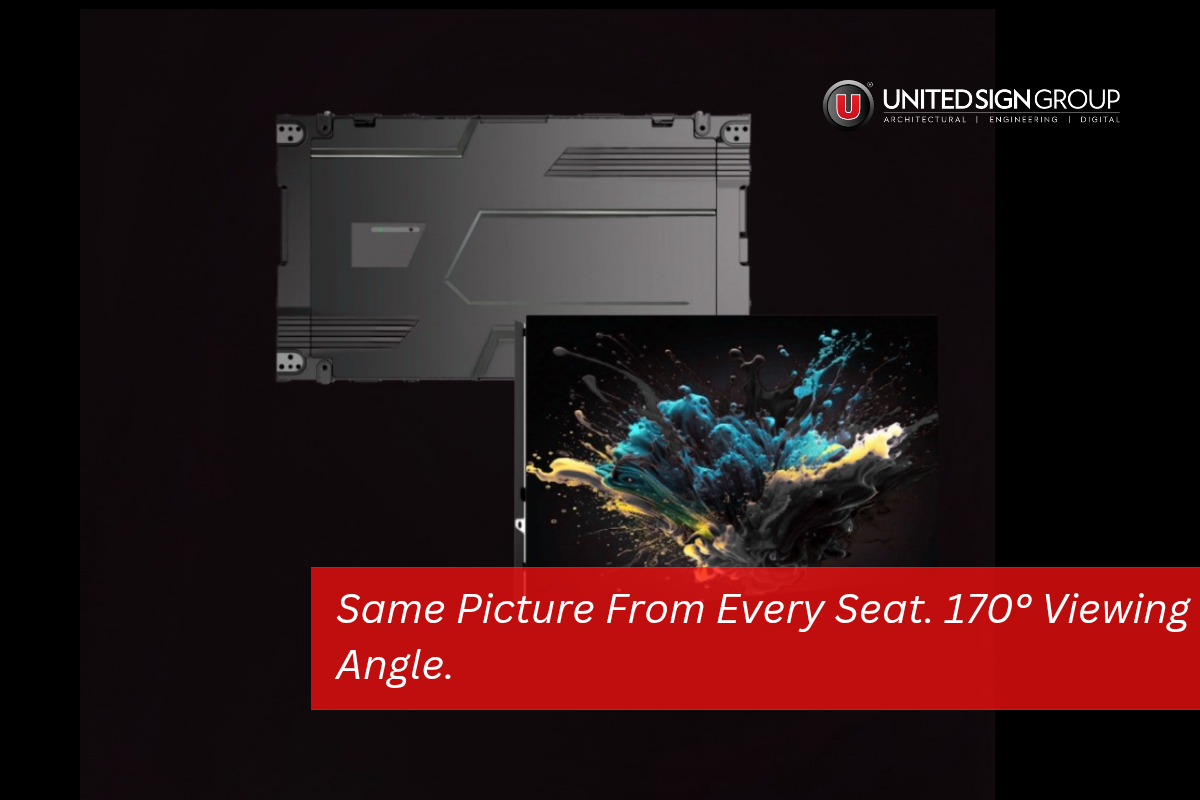
Pixon from United Signs is built for rooms where people aren’t lined up neatly, like lobbies, showrooms and briefing rooms. With a 170° rating you can plan seating, walkways, and mounting height around how the space works instead of around the screen.
FAQs: LED Display Viewing Angle
Around 140° is common for indoor panels. Fine-pitch COB often reaches 160° or more, which helps when viewers sit wide or stand close.
No. It marks where brightness or contrast falls to a set limit. Some fall-off happens before that, so ask how the maker tested it.
Usually. The flat surface spreads light more evenly, and it also gives deeper blacks and a tougher face. Check the exact model’s datasheet.
If people watch from the sides, from close up, or from well above or below eye level, it does.
Talk Through Your Room with Us
Every room has its awkward corners. There’s the side seat nobody wants, the walkway that cuts across the screen, and a mounting height someone settled on before the display was even chosen.
Send us a floor plan or a few photos and we’ll go through where people will stand and sit, then check that against what Pixon can do. You’ll know how the picture holds up before anything gets ordered. Review your viewing conditions with us.