LED signage in Los Angeles competes with some of the busiest, most visually saturated streetscapes in the country. From Hollywood entertainment campuses to Beverly Hills retail corridors, a display here has to earn attention. And that’s not easy in a city built entirely around competing for it. Understanding what actually makes a sign work in LA matters before you commit to a design.
Why LED Signage in Los Angeles Faces a Different Kind of Competition
Los Angeles spans dozens of distinct neighborhoods, and each one carries its own zoning district and sign rules. Burbank and Culver City lean into the entertainment industry. Beverly Hills leans toward luxury retail. El Segundo leans on the tech corridor. A display that works in one district might feel completely out of place in another. It could even run into permitting issues.
Every commercial sign in the city must clear LADBS building and electrical permits and meet California Title 24 illumination standards. In many areas, additional sign district ordinances apply on top of that. Because of this, understanding your specific district matters as much as the creative concept itself.
LED Signage in Los Angeles: Fitting the Streetscape
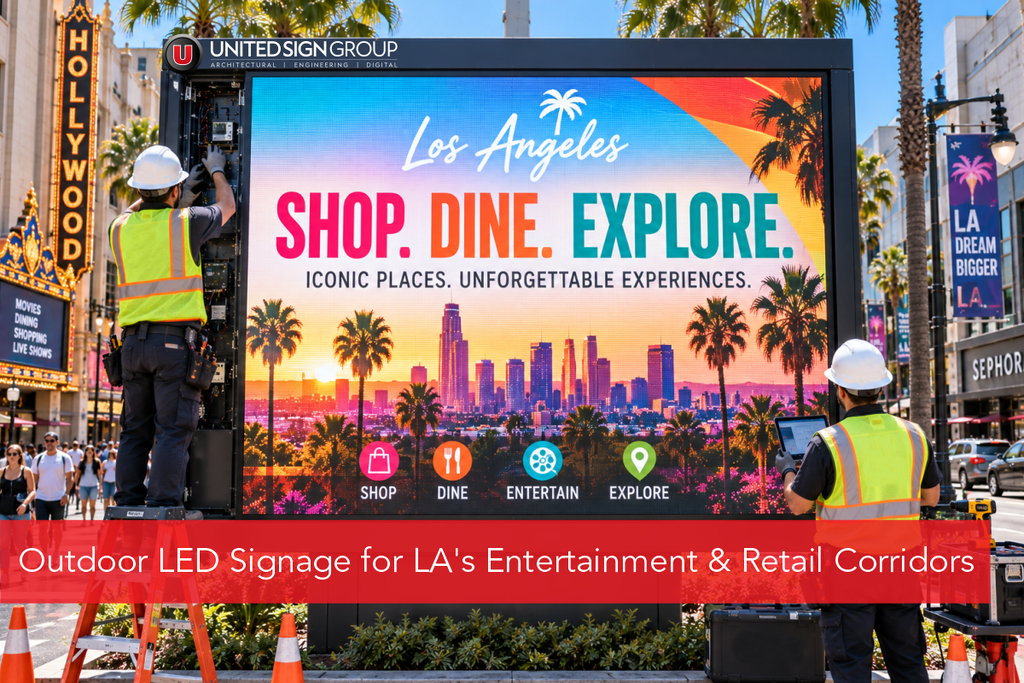
Walk down any entertainment or retail strip in LA, and you’ll see signage go big and bright; that’s just how these corridors work. But going bigger doesn’t automatically make a sign better. The good ones pay attention to brightness, how fast the message changes, and size, and they tune all of that to match the block they’re actually on.
LED signage in Los Angeles also has to hold up structurally, not just visually. Ground-mounted entry signage in LA County gets engineered to California seismic and wind load requirements. Earthquake activity is a real design consideration here, in a way it isn’t in most other markets.
Brightness Rules for LED Signage in Los Angeles
Programmable LED signs across Greater LA need to meet California Title 24 and LADBS electrical standards. Illuminated signs must comply with CALGreen energy and brightness rules enforced by LADBS, and structural components need engineering to California seismic and wind load specifications.
For outdoor digital displays specifically, zoning eligibility gets evaluated based on proximity to freeways and residential zones before design even begins. Skipping this step early is one of the most common ways a project stalls later at plan check.
What Makes LA’s Sign Code Different From Other Markets
Ordinance 188,418, better known as the LA Sign Code, sets the ground rules here. It covers what sign types you’re allowed, how big they can be, how bright, and where you can put them across the city. On top of that, plenty of commercial and entertainment zones layer on their own sign district requirements, so the base code is really just the starting point in a lot of neighborhoods.
This is where LADOT coordination sometimes enters the picture too. Signs visible from public roadways may need LADOT input alongside the standard LADBS process, particularly for anything near a freeway corridor.
LED Signage in Los Angeles: A Quick Checklist
- Confirm your neighborhood’s zoning district and sign district status. Rules shift block by block across LA in a way few other cities match.
- Check illumination limits under Title 24 and CALGreen. Brightness compliance is enforced by LADBS, not left to interpretation.
- Ask about seismic and wind load engineering. Ground-mounted and structural signage needs specs built for Southern California conditions.
- Evaluate freeway and residential proximity for digital displays. This affects zoning eligibility before design work starts.
- Plan for both a building permit and an electrical permit. Illuminated signage in LA requires both, filed and coordinated together.
- Budget realistic time for plan check. Sign districts and LADOT coordination can extend standard timelines.
Materials That Hold Up for LED Signage in LA
Beyond code compliance, LED signage in Los Angeles needs to survive the region’s specific environmental stress. Marine layer moisture affects coastal-adjacent properties, while inland areas deal with sustained heat cycles that wear down lower-grade components faster. Seismic-rated mounting hardware matters here in a way it simply doesn’t in most other US markets, given the region’s ongoing seismic activity.
Materials selected without these conditions in mind tend to show wear years ahead of schedule, especially corrosion around seams and connection points near the coast.
Why This Matters for LA Business Owners
A poorly planned display in Los Angeles risks more than a design mismatch. It risks permitting delays, code violations, or a structure that isn’t actually rated for the seismic and wind conditions of its site. Getting the zoning, illumination, and structural requirements right from the start avoids costly redesigns down the line.
Local Expertise Makes the Difference
Sign districts, Title 24 rules, and seismic requirements, it’s a lot to keep straight if you’re not dealing with it every day. United Signs is. We’ve put up more than 10,000 signs across Los Angeles, and we handle every step ourselves, design, permitting, fabrication, installation, without handing any of it off to outside vendors.
If your business is planning LED signage in Los Angeles for an entertainment or retail corridor, it’s worth a conversation before design work begins.
FAQs
No. Zoning districts and sign district overlays vary by neighborhood, so a sign that’s compliant in one part of the city might not meet requirements in another.
Digital displays must meet California Title 24 illumination standards and CALGreen energy and brightness rules, all enforced by LADBS as part of the permitting process.
Southern California’s seismic activity means ground-mounted and structural signage needs engineering built for local wind load and earthquake conditions, not a generic national spec.
Most installations complete within a few weeks after permit approval, though sign districts or LADOT coordination for roadway-adjacent signs can extend that timeline.