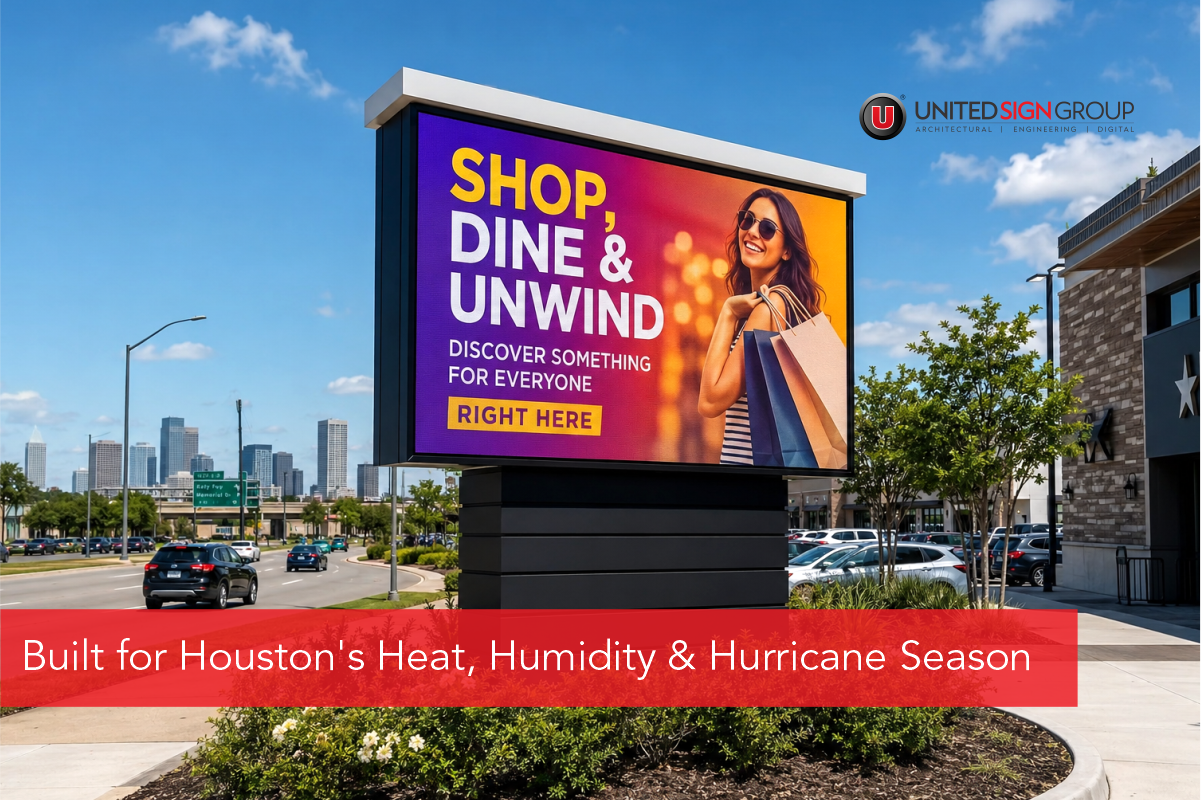
Outdoor LED signage in Houston has to survive thick humidity, triple-digit heat indexes, and a hurricane season that runs for months. Most displays were never built for these conditions. A display designed for a milder climate wears down fast here. If you own a business in Greater Houston, know what your display actually needs to handle before you commit to a build.
Why Outdoor LED Signage in Houston Needs Different Engineering
Sustained heat and Gulf Coast humidity create a tough combination for outdoor electronics, a direct result of Houston’s humid subtropical climate. Heat pushes internal components to their limits, while humidity works into any gap it can find, corroding parts and shortening a display’s usable life. Add tropical storm and hurricane exposure into the mix. Houston signage needs engineering that most other regions simply don’t require.
United Signs builds outdoor LED signage in Houston with materials rated for high-humidity corrosion, hurricane-force wind loads, and sustained extreme heat, since a display engineered for a drier or milder climate won’t hold up the same way here.
Outdoor LED Signage in Houston Needs Strong Wind Ratings
Houston sits in a wind speed zone that demands real structural engineering, not a generic outdoor rating. Crews must engineer all signage fabricated and installed in the Houston market to Houston Construction Code structural specifications, including Gulf Coast wind load ratings. Qualifying permit submissions include sealed engineered drawings.
This matters across Harris, Fort Bend, Montgomery, and Galveston counties alike, since hurricane season affects the whole region, not just properties closest to the coast.
Brightness Rules Are Part of the Engineering, Not an Afterthought
Houston enforces specific digital signage rules that go beyond weather resistance. Digital displays face brightness limits of 6,500 nits during daytime and 1,250 nits at night. Messages can’t change more than once every five minutes, and transitions must complete within one second. Every sign also needs a light-sensing device to automatically adjust brightness.
These aren’t optional guidelines. A display built without them in mind can run into permitting delays or fail inspection outright, so this needs to be part of the design conversation from day one, not something addressed after the fact.
Houston’s Permitting Process Adds Another Layer
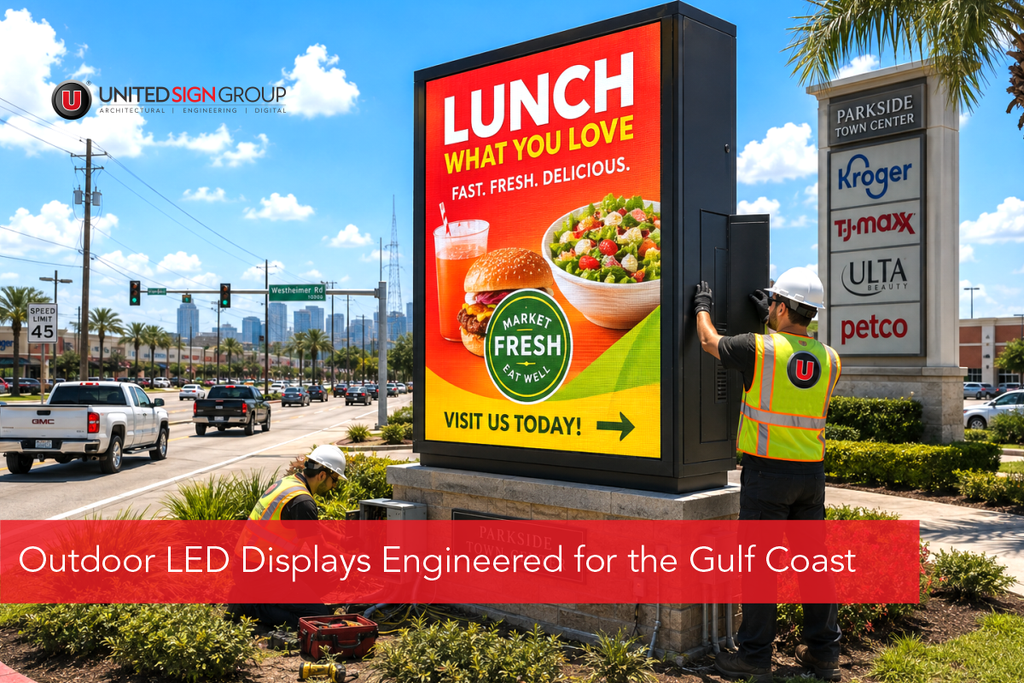
Because Houston doesn’t have traditional zoning, sign rules come from street category classifications, deed restrictions, scenic corridor designations, and the Houston Sign Code instead. Houston Sign Administration issues all commercial sign permits. Applications go through the iPermits portal, and plans are uploaded to ProjectDox for review. A senior inspector must visit the site before installation can begin. Illuminated signs also require a separate electrical shop inspection.
Businesses are limited to five signs total, typically a mix of ground, projecting, wall, and marquee types, with specific frontage rules determining how many ground or projecting signs a property can have.
Checklist for Outdoor LED Signage in Houston
- Confirm your street category and scenic corridor status. Sign height, size, and lighting limits depend on the street your property faces, not a citywide standard.
- Ask about wind load engineering specific to your zone. Include sealed engineering drawings with any qualifying permit submission.
- Check that your display meets Houston’s brightness and transition rules. 6,500 nits daytime, 1,250 nits nighttime, and automatic light-sensing adjustment aren’t optional.
- Verify materials are rated for Gulf Coast conditions. Build in humidity corrosion resistance and hurricane wind ratings from the start, not later.
- Plan for both a standard permit and an electrical shop inspection if your sign is illuminated.
- Confirm your county’s specific code differences. Requirements can shift between Harris, Fort Bend, Montgomery, and Galveston counties.
Why Outdoor LED Signage in Houston Is a Long-Term Investment
Outdoor LED signage in Houston represents a long-term investment, and Houston’s climate doesn’t give underbuilt signage much room for error. A display that fails brightness compliance, corrodes early, or can’t handle hurricane-season wind costs more in repairs and permitting delays. Building it correctly from the start avoids that.
Local Expertise Makes the Difference
Houston’s mix of climate demands and code complexity is easier to manage with a team that handles it regularly. United Signs has installed 10,000+ signs across Harris County and the broader Greater Houston region. Our team manages design, engineering, Houston Sign Administration permitting, fabrication, and installation in-house.
If your outdoor LED display needs to hold up through another Houston summer and hurricane season, it’s worth a conversation before design work begins.
FAQs
We engineer all signage fabricated and installed in Houston to Houston Construction Code structural specifications, including Gulf Coast wind load ratings, and include sealed engineering for qualifying permits.
Digital displays max out at 6,500 nits during the day and 1,250 nits at night. Messages can change no more than once every five minutes, with transitions completing within one second. Every sign needs a light-sensing device to automatically adjust brightness.
The Houston Sign Code allows up to five signs per business, typically a mix of ground, projecting, wall, and marquee signs, with specific frontage rules determining how many ground or projecting signs are allowed.
Yes. Without conventional zoning, sign rules are based on street category classifications, deed restrictions, and scenic corridor designations rather than standard zoning districts.