If you’ve ever ordered signage for a business, campus, or public space, you’ve likely run into one of two approaches, and picking the right design-build sign company can make or break how smoothly that project goes. One is the traditional route: a design firm creates concepts, a separate fabricator builds them, and sometimes a third company installs everything. The other is design-build, where one company manages the entire process from concept through installation.
On paper, the difference sounds small. In practice, it changes how a project actually runs.
The Traditional Split, and Where It Breaks Down
In a traditional signage project, a different party handles each phase. That handoff is where problems tend to start.
- A designer creates renderings without always knowing what a fabricator can build within budget
- The fabricator receives finished drawings and finds a specified material or mounting method isn’t practical for the site
- As a result, that triggers revisions, which push back the schedule and often the budget too.
In fact, none of this is rare. This risk is built into any process where the people planning a sign and the people building it aren’t talking early enough.
How Design-Build Changes the Sequence
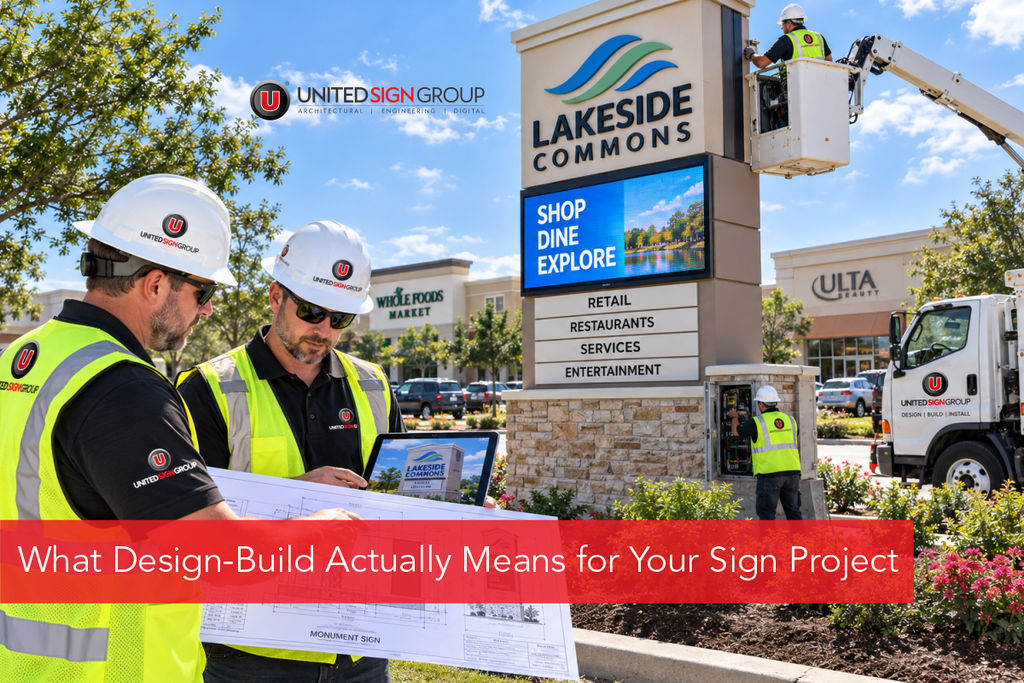
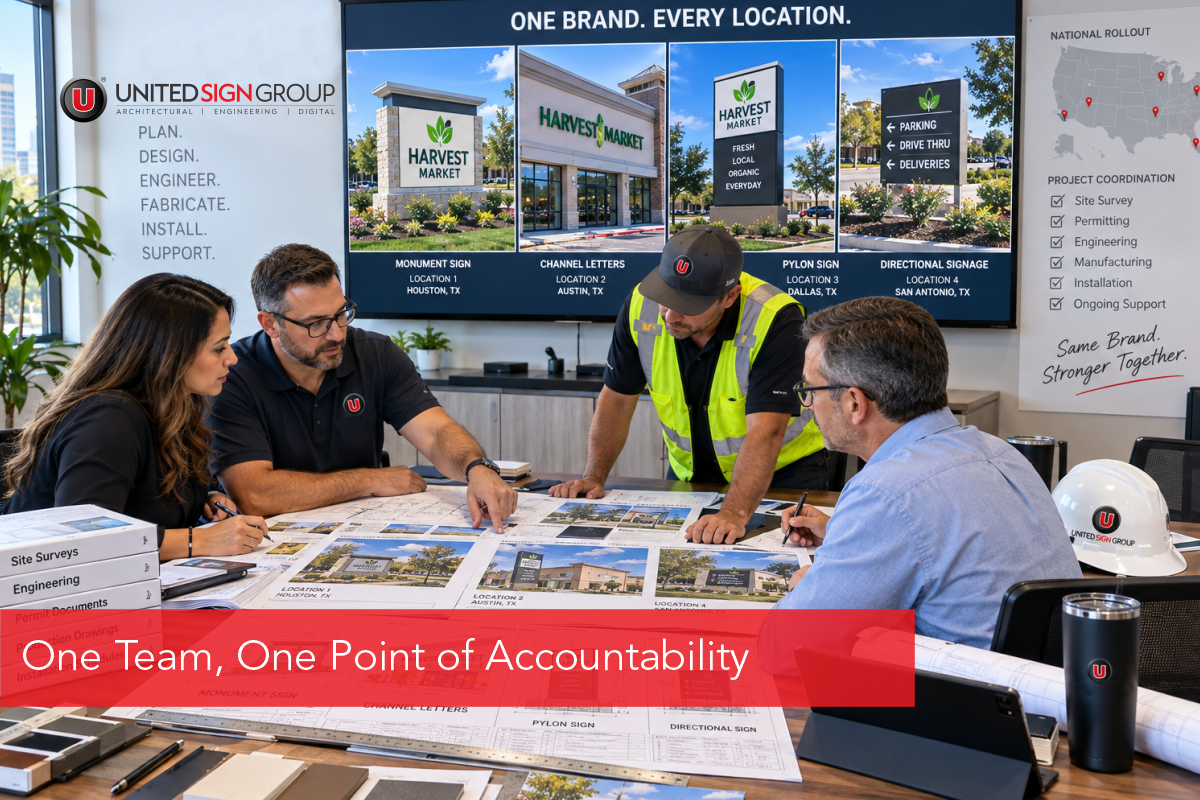
Design-build signage puts design, engineering, fabrication, and installation coordination under one point of accountability. Even so, one company manages the full scope of a program, even when parts of the work run through a coordinated network of partners and regional locations rather than a single building.
A typical design-build signage program moves through a connected sequence:
- Field survey – map existing signage and identify points where someone could reasonably lose their way
- Routing plan and message schedule – decide what each sign needs to say and where it needs to go
- Concept design and engineering – the team develops these together, so nothing gets finalized until they check it against real structural and site constraints
- Prototype – many programs build one full sign for field testing before committing to full production
- Fabrication and installation – the same team that shaped the plan carries this out from the start
United Signs structures its programs this way, coordinating five connected service areas:
- Design and consultation
- Engineering
- Manufacturing
- Installation
- Project management, with a dedicated project manager
That structure means the people who understand structural code requirements and site limitations help shape a sign concept from the start, not after the fact.
Where This Matters Most
The value shows up clearest on programs with a lot of moving parts. A citywide wayfinding program might involve a field survey, a routing study to find where visitors lose their way, a coordinated sign family design, engineering review, and phased installation across dozens of locations. An interior program for a large facility, like a hospital, brings its own complexity: ADA compliance, tactile and Braille requirements, wall and ceiling conditions that vary room to room, and installation sequencing that has to work around a facility still in daily operation.
On projects like these, coordinating design and fabrication from the start means fewer surprises later. The team develops a sign family with a realistic sense of engineering and installation costs upfront. That beats getting a design approved and priced, only to redesign it once a fabrication issue turns up.
What Design-Build Does Not Mean
Worth being precise here. Design-build doesn’t mean one team physically performs every task in-house, in one building. Instead, large sign programs, especially ones spanning multiple states or facility types, often draw on a coordinated network of manufacturing capacity, licensed engineers, and certified installation crews working regionally.
What design-build actually guarantees is accountability:
- One point of contact manages the program
- One company is responsible for the outcome
- There’s no gap between who designed a sign and who has to explain why it doesn’t fit the wall it needs to hang on.
A Practical Comparison
Think of it like hiring a general contractor to build a house. Compare that to hiring an architect, a framing crew, an electrician, and a painter separately, then coordinating them yourself. Either way, the materials and labor can overlap. Ultimately, what changes is who owns the outcome, and how early the practical realities of construction get factored into the design.
Signage works the same way. A design-build sign company brings engineering and fabrication knowledge into the process while a concept is still taking shape, not after it’s already approved and priced.
The Bottom Line
A design-build sign company isn’t a marketing label. It’s a specific way of structuring a signage project so one company holds responsibility for the whole outcome, coordinating design, engineering, permitting support, fabrication, project management, and installation, even when execution runs through a broader network of manufacturing and installation resources. Overall, for businesses, cities, and institutions running signage programs with real complexity, that coordination is often the difference between a project that stays on schedule and one that doesn’t.
If you’re planning a signage program and want to see what a coordinated design-build approach looks like for your project, request a quote from United Signs.
FAQs
In a traditional project, separate companies handle design, fabrication, and installation, with handoffs between each. Design-build puts one company in charge of the entire process. The same team that designs the sign stays accountable for how they engineer, build, and install it.
Not necessarily. Design-build refers to accountability, not physical location. Large programs often draw on a coordinated network of manufacturing partners, licensed engineers, and regional installation crews, but one company remains responsible for the outcome.
It adds the most value to programs with a lot of moving parts, like citywide wayfinding or multi-location rollouts. Still, the core benefit, catching structural or site issues before finalizing a design, applies to smaller projects too.
The team factors in engineering and fabrication knowledge while the concept is still taking shape. That means problems that would normally surface after approval, like a material that isn’t practical for the site, get caught earlier, before they trigger costly revisions.