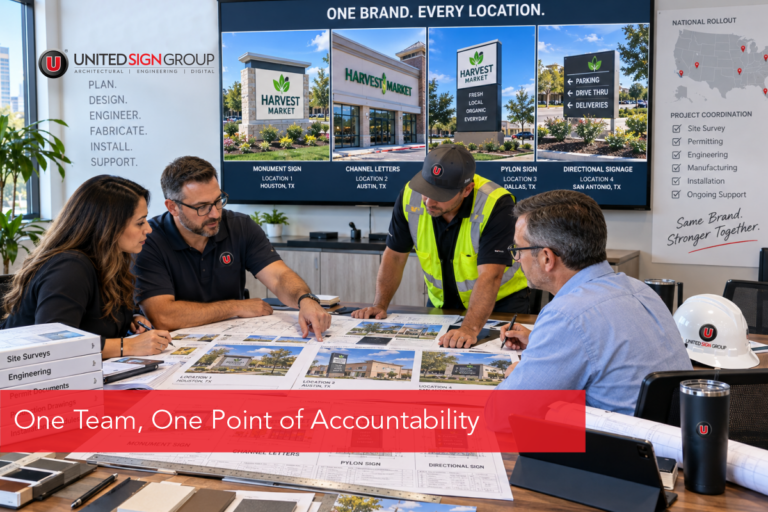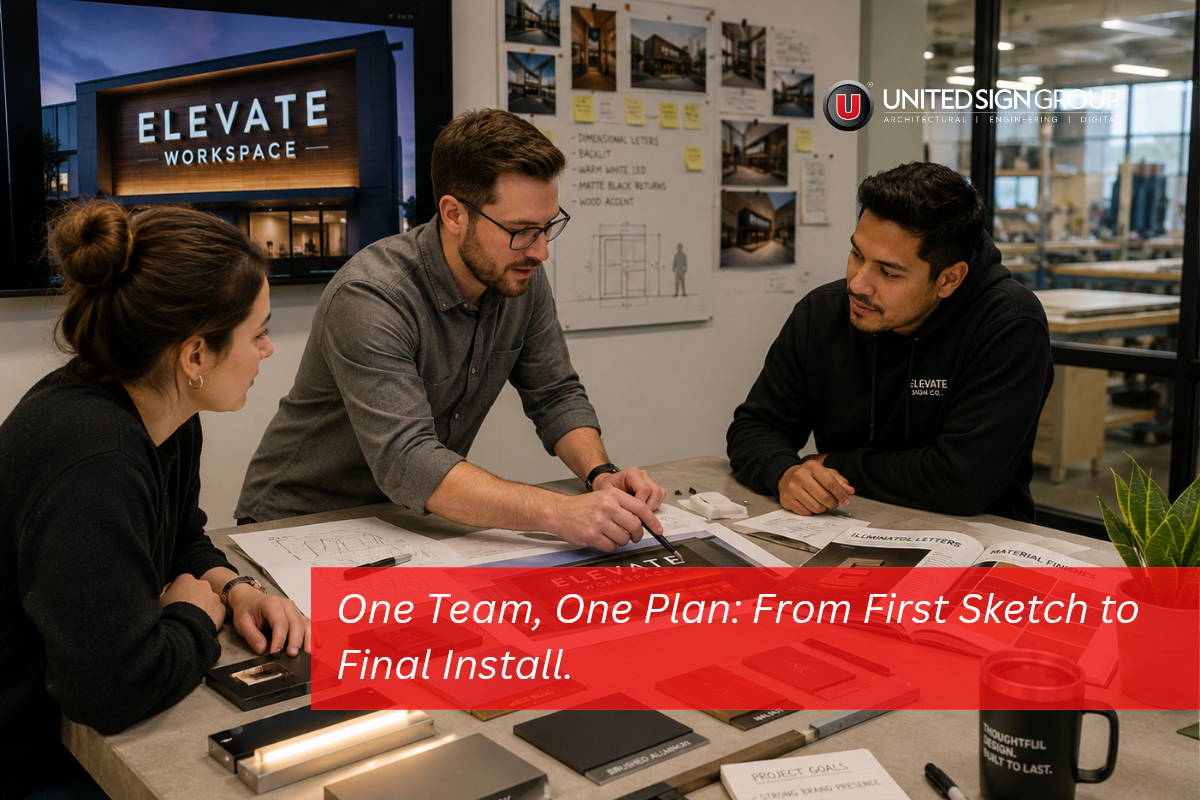
Design-build signage puts design and fabrication under one roof. That’s really the whole idea; one team draws the concept, then builds it, instead of handing your project between companies that have never spoken to each other.
Property owners used to have no choice. Hire a design firm. Wait. Hire a fabricator. Wait again, and hope the fabricator can actually build what the designer drew. Design-build skips that hand-off entirely.
United Signs runs its projects this way, and the difference tends to show up early, usually before a single sign leaves the shop floor.
What Is Design-Build Signage?
Design-build signage means one company owns the whole job: the concept art and the physical construction. The person sketching the sign works alongside the person who welds its frame and wires its lights.
Compare that to how signage projects usually go. An architect or design consultant draws up specs. He then hands them off to a fabricator who wasn’t in the room when those specs got approved. That gap is where budgets creep, timelines stretch, and nobody quite wants to own the mistake. The Design-Build Institute of America describes the same principle for construction broadly; one contract, one team, one point of accountability. Signage isn’t any different.
How It Works
A design-build signage program has three moving parts, and they must move together, not in sequence.
One Point of Contact
You call one company. That’s it. They handle concept art, engineering, permitting, fabrication, and installation; every phase, one phone number. Nobody has to referee a disagreement between a design firm and a fabricator over what’s actually buildable, because it’s the same people on both sides of that conversation.
Design and Fabrication, Planned Together
Designers and builders sit at the same table from the start. So a concept doesn’t get sent back for a redesign three months in because nobody checked whether it could be built on budget. The people who know what a weld costs, or how a Braille insert has to mount, weigh in while the design is still just a sketch, not after a client has already signed off on it.
Concept to Construction, One Team, No Hand-Offs
The team that draws the specs is the same one that builds and installs them. A shop drawing doesn’t have to reinterpret someone else’s design file, because it was never someone else’s to begin with. And when a field survey turns up something unexpected (a load-bearing wall where a sign was supposed to hang, say) that information goes straight back to the people who can adjust for it, instead of triggering a change order between two companies that have never met.
Curious how this applies to your own site? Take a look at United Signs’ wayfinding and directional signage services.
Key Benefits of Design-Build Signage
Timelines Move Faster
Phases overlap instead of stacking up one after another. Engineering can start before every design revision is locked. Procurement can begin once materials have a green light, without waiting on final drawings. That overlap is usually the entire gap between a program that wraps in a few weeks and one that limps along for months.
Costs Stay Predictable
Fabricators weigh in on price before a design is final, not after. That one shift means a client almost never reaches the end of a design phase only to learn the concept they approved costs twice what they budgeted. Cost and design move together instead of pulling against each other.
Nobody Gets to Point Fingers
There’s no outside designer to blame, no separate contractor to chase down. One team owns the outcome, start to finish, so when something goes sideways, it gets fixed instead of argued about. It tends to raise the bar on quality, too. The people who built the sign designed it, which means they’ve got a stake in both halves of the job.
Design-Build Signage in Action
United Signs is running this exact model on two projects right now that don’t look anything alike on paper. One is an interior wayfinding program inside a medical facility, built around strict ADA and federal accessibility requirements. The other is a citywide wayfinding system, guiding drivers and pedestrians through a historic downtown and its public parking. Different codes. Yes, different audiences. Different everything, really, except the backbone underneath both projects: one team, planning together from day one, answering to nobody but the client. We’ll dig into each project on its own in the next two posts, including how the routing got planned, how the sign families came together, and how each rollout got phased.
Curious how this applies to your own site? Take a look at United Signs’ wayfinding and directional signage services.
Simplify Your Next Signage Program
Planning a wayfinding, directional, or architectural signage project? If you want one team accountable from the first sketch to the final install, talk to United Signs about a design-build proposal. We’ll walk your site, your timeline, and your compliance needs before anyone draws a single sign.
FAQs
Usually, no. Because fabricators price the design early, expensive redesigns rarely happen. Most clients come out ahead once you account for the rework costs that separate vendors have no way to coordinate around.
Projects with tight timelines, strict compliance rules, or a lot of sign types spread across a big site. Interior wayfinding for hospitals and citywide municipal wayfinding are both good examples, either one means coordinating a lot of moving parts across a lot of stakeholders.
Not quite. “Turnkey” often just means one invoice, even if the work still gets farmed out to different subcontractors behind the scenes. Design-build specifically means the same internal team designs, engineers, fabricates, and installs (no hand-off to an outside vendor at any point).